
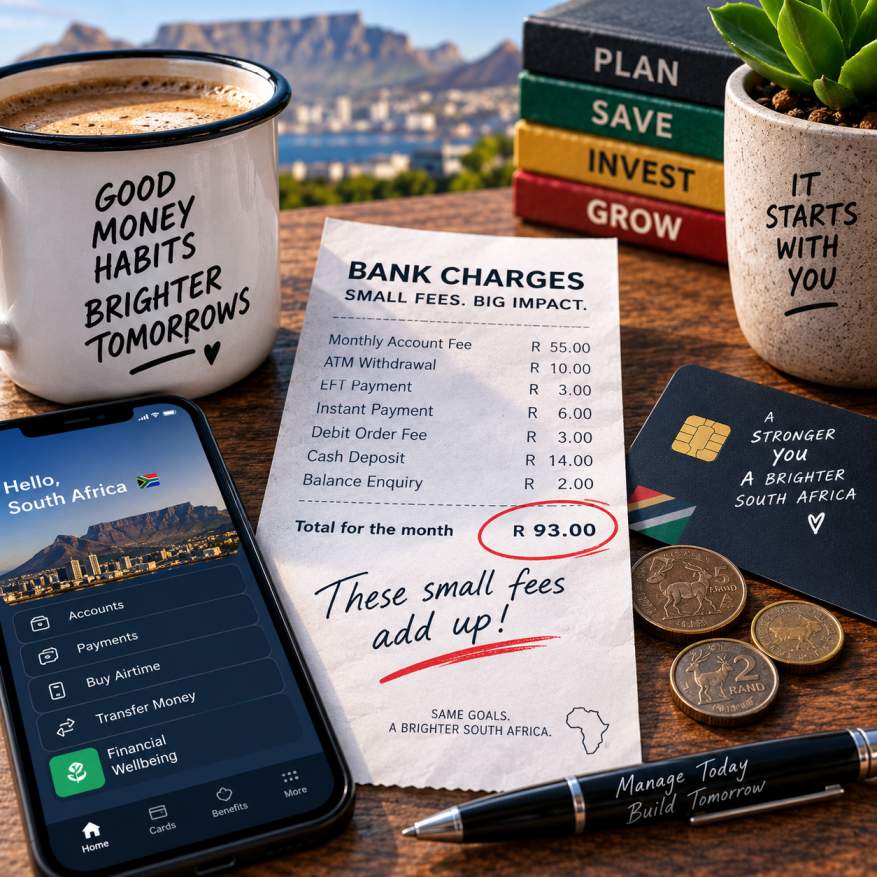
Bank charges are one of those expenses that are easy to ignore.
R2 here. R6 there. R10 for a withdrawal. A monthly account fee. Another charge for an instant payment. Perhaps a cash-deposit fee at the end of the month.
Individually, most of these amounts don’t look particularly serious.
But when you add them together over 12 months, the picture can look very different.
Imagine spending just R150 per month on banking fees. That’s:
R1,800 per year.
At R250 per month, you’re spending:
R3,000 per year.
For a South African household trying to save money, pay off debt or simply make a salary stretch until payday, that’s money worth paying attention to.
The good news is that many banking fees are avoidable or can at least be reduced.
The key is understanding what you’re being charged for, how your bank account’s pricing structure works, and which everyday banking habits are quietly costing you money.
This guide explains the most common bank charges in South Africa, from monthly fees and ATM withdrawals to EFTs, instant payments, debit orders and cash deposits. More importantly, we’ll look at practical ways to reduce what you spend without giving up the banking services you actually need.
Why Do South African Banks Charge Fees?
Banks provide far more than somewhere to store money.
A modern transactional bank account can give you access to:
- Debit and virtual cards
- ATMs
- Banking apps
- Online banking
- EFT payments
- Debit orders
- Cash deposits
- Cash withdrawals
- Fraud monitoring
- Statements
- Payment notifications
- Customer support
- Branch infrastructure
- Payment networks
Maintaining those systems costs money.
Banks recover some of those costs through account and transaction fees.
Nedbank, for example, explains that banking fees contribute toward access to digital channels, ATMs, contact centres and branches, as well as keeping accounts operational and secure. (Nedbank Personal)
The important point for consumers isn’t whether banks should charge fees.
It’s understanding how much your particular banking behaviour costs you.
Two people with the same bank can have completely different monthly banking costs simply because they use their accounts differently.
The Two Main Ways Bank Accounts Are Priced
South African transactional accounts commonly use variations of two pricing approaches.
Pay-as-you-use
With a pay-as-you-use account, the monthly account fee may be relatively low, but you pay separately for certain transactions.
You might pay individually for:
- EFTs
- Debit orders
- ATM withdrawals
- Cash deposits
- Instant payments
This can work well for someone who doesn’t transact very often.
But if you’re making dozens of paid transactions every month, those little charges can accumulate.
Bundled banking
Another account may charge a higher fixed monthly fee but include certain transactions in the package.
For example, your monthly fee could include a number of:
- EFTs
- Debit orders
- ATM withdrawals
- Card transactions
- Other services
This can work well for a frequent user.
But if you’re paying R200 or R300 per month for a premium package and barely using its included benefits, you may be paying for banking you don’t need.
Neither pricing model is automatically cheaper.
The cheapest one depends on how you actually bank.
The Most Common Bank Charges in South Africa
Let’s break down the fees you’re most likely to encounter.
1. Monthly Account Fees
This is usually the easiest charge to identify.
You pay a fixed amount each month simply for maintaining or accessing the account and its associated services.
Depending on the account, this could range from a relatively small amount to hundreds of rand for premium banking packages.
For example, Capitec’s Main Account currently has a R7.50 monthly administration fee, while Absa’s Flexi Account currently advertises a R55 monthly fee. The accounts are not equivalent products, so this isn’t a direct “which bank is cheaper” comparison — it simply demonstrates how different account structures can be. (Capitec Bank)
A R7.50 monthly fee equals:
R90 per year.
A R55 monthly fee equals:
R660 per year.
A hypothetical R250 monthly banking package equals:
R3,000 per year.
That’s why the first question to ask is:
Am I getting enough value from my account to justify its monthly fee?
Don’t Choose an Account Based Only on the Monthly Fee
A R10 account isn’t automatically cheaper than a R100 account.
Suppose Account A costs:
R10 per month
but you separately pay for most transactions.
Account B costs:
R100 per month
but includes many of the transactions you regularly perform.
If you’re a heavy user, Account B could potentially cost less overall.
Your real banking cost is:
Monthly fee + transaction fees + other charges
not merely the advertised monthly account fee.
2. ATM Withdrawal Fees
Cash withdrawals are one of the easiest ways to accumulate banking charges.
The fee can depend on:
- Your bank
- Your account
- Which ATM you use
- How much you withdraw
- Whether you use a retailer till instead
- Whether you’re withdrawing internationally
Nedbank’s consumer guide, for example, explains that using another bank’s ATM can be more expensive than using your own bank’s ATM, while branch withdrawals can carry their own charges. (Nedbank Personal)
Capitec’s current 2026 pricing provides another example. It charges R10 per R1,000 withdrawn at any South African bank’s ATM, while a supermarket till-point withdrawal costs R2. (Capitec Bank)
These are examples rather than universal rates.
Your own bank’s pricing may be completely different.
Why Several Small Withdrawals Can Cost More
Imagine your account charges you per ATM withdrawal.
You withdraw:
Monday: R200
Wednesday: R300
Friday: R400
Sunday: R200
You’ve made four withdrawals.
If you’d planned your cash requirements better, perhaps one larger withdrawal could have replaced several transactions.
However, you need to check how your particular bank calculates withdrawal fees.
Some charge a flat fee.
Others use an amount-based calculation.
Others include certain withdrawals in a bundle.
So the old advice of “always make one large withdrawal” isn’t universally correct.
The better rule is:
Understand your account’s withdrawal formula and plan accordingly.
ATM Fees Aren’t Just Random Numbers
There is an underlying payment infrastructure involved when one bank’s customer uses another bank’s ATM.
The South African Reserve Bank publishes interchange rates applying within the payment system. As of its February 2026 schedule, the ATM cash-withdrawal interchange rate was R5.31 plus 0.64% of the withdrawal amount, excluding VAT. (Reserve Bank of South Africa)
That’s an interchange rate between participants in the payment system — not necessarily the fee your bank charges you.
Your retail fee depends on your bank and account.
But it helps explain why using banking infrastructure can involve costs behind the scenes.
3. Cash-at-Till Withdrawals
One of the easiest ways some consumers can reduce cash withdrawal costs is by withdrawing money at participating retailers.
You buy your groceries and request:
R500 cash back.
The retailer processes the withdrawal along with your card transaction.
Depending on your bank, this can be substantially cheaper than using an ATM.
Standard Bank recommends considering till-point withdrawals as one way to reduce banking costs. (Standard Bank)
But check your account’s current fee schedule before assuming.
4. EFT Fees
An Electronic Funds Transfer (EFT) allows you to send money electronically from your bank account to another account.
Examples include:
Paying rent.
Sending money to a family member.
Paying a supplier.
Transferring money to another bank.
The cost depends on your account.
Some accounts include ordinary electronic payments.
Others charge per transaction.
For example, Capitec’s current 2026 Main Account pricing lists:
R1 for a payment to another Capitec account.
R2 for a payment to another South African bank. (Capitec Bank)
Other banks and accounts use different pricing.
The lesson isn’t that R1 or R2 is expensive.
It’s that transaction frequency matters.
How Small EFT Charges Accumulate
Suppose your bank charges:
R3 per ordinary EFT.
You make:
20 payments per month.
That’s:
R60 per month
or:
R720 per year.
If your account already costs R100 per month, you’re now potentially spending:
R1,920 per year
on the monthly account fee and these hypothetical EFTs alone.
That’s before ATM withdrawals, instant payments, deposits or other fees.
5. Instant Payment Fees
An ordinary EFT and an instant payment aren’t necessarily the same thing.
When you need someone to receive money urgently, you may choose an immediate or real-time payment option.
That convenience can cost extra.
For example, Capitec currently charges R6 for an immediate payment to another South African bank, compared with R2 for its standard payment to another South African bank. (Capitec Bank)
Other banks use different structures.
This creates a simple opportunity to save:
Ask yourself:
Does this payment actually need to arrive immediately?
If the answer is no, use the cheaper standard option where appropriate.
“Instant” Is Convenient — That’s Why It’s Easy to Overuse
Imagine sending five instant payments per week.
If the difference between your standard and instant-payment fee were hypothetically R5, that’s:
R25 per week
or roughly:
R1,300 per year.
You’re effectively paying R1,300 annually because you don’t want to wait for normal payment processing.
Sometimes instant payment is worth it.
Perhaps you’re buying something and the seller won’t release it until payment clears.
Maybe there is a genuine emergency.
But paying an instant-payment premium for routine transactions that could have been scheduled earlier is unnecessary.
6. Debit Order Fees
A debit order allows an authorised service provider to collect money from your bank account.
Common examples include:
- Insurance
- Cellphone contracts
- Gym memberships
- Streaming services
- Personal loans
- Vehicle finance
- Home loans
Depending on your account, debit orders may be free, included in your package or charged individually.
For example, Capitec currently charges R3 per debit order on its Main Account. (Capitec Bank)
If you had:
10 debit orders × R3 = R30 per month
that’s:
R360 per year.
Again, your bank’s pricing may differ.
7. Unpaid Debit Order Fees
This is where banking mistakes can become unnecessarily expensive.
Suppose your insurance debit order is scheduled for the 25th.
The amount is:
R1,200
but you have only:
R1,100
in the account.
The debit order fails.
Depending on the bank and account, you may incur an unpaid or returned debit-order fee.
The service provider may also have its own consequences for the missed payment.
Capitec’s current pricing, for example, lists a R6 returned debit-order fee for insufficient funds. Other banks and products have their own pricing structures. (Capitec Bank)
The easiest way to avoid this fee?
Know when your debit orders run.
Build a Debit Order Calendar
Create something simple:
| Date | Debit Order | Amount |
|---|---|---|
| 1st | Rent | R7,500 |
| 2nd | Insurance | R950 |
| 5th | Cellphone | R650 |
| 15th | Streaming | R120 |
| 25th | Loan | R1,200 |
Now you know exactly what needs to remain in the account.
This can prevent the frustrating situation where you spend R500 over the weekend and discover on Monday that a debit order bounced because the account was R200 short.
8. Cash Deposit Fees
Cash can be expensive to handle.
If you regularly deposit physical cash, pay close attention to deposit fees.
Banks may charge according to:
- Amount deposited
- Deposit channel
- Account type
- ATM versus branch
- Retail deposit facilities
Nedbank explicitly lists cash deposits as a type of transaction that can attract a fee. (Nedbank Personal)
Capitec’s current personal-account pricing, for example, charges R1.40 per R100 deposited at its ATMs and selected supermarket till points. (Capitec Bank)
At that illustrative real-world rate:
R1,000 cash deposit = R14
R5,000 = R70
R10,000 = R140
For someone paid primarily by EFT, this won’t matter much.
For a cash-heavy small business or side hustle, it matters enormously.
9. Branch Transaction Fees
Walking into a branch and asking a consultant to perform something you could have done in the app can sometimes cost significantly more.
Banks have invested heavily in digital banking partly because electronic transactions are more efficient.
You may therefore find different pricing for:
App
versus:
ATM
versus:
Branch.
Standard Bank advises consumers to make use of alternative channels and monitor their statements to understand where their banking fees are coming from. (Standard Bank)
The general rule is:
If you can safely perform a routine transaction digitally, check whether doing so is cheaper.
Of course, some matters genuinely require branch assistance.
10. Balance Enquiry Fees
Yes, even checking your balance can sometimes cost money depending on where you do it.
Checking your balance in your banking app may be free while checking it at an ATM could attract a fee on some products.
Standard Bank specifically recommends checking balances online or by phone rather than using an ATM if the ATM enquiry attracts a charge. (Standard Bank)
This is a perfect example of an avoidable fee.
If the app gives you the same information for free, paying an ATM to show your balance doesn’t make much sense.
11. Bank Statement Fees
Digital statements are commonly available through banking apps or online banking.
But requesting printed, posted, historical or bank-certified statements may attract fees depending on your bank.
Before visiting a branch and asking someone to print six months of statements, check your app.
You may be able to download the same statements yourself.
Save them as PDFs.
Email them.
Print them only if you genuinely need paper copies.
12. Card Replacement Fees
Lose your physical bank card and replacing it may cost money.
The amount varies by bank and account.
Capitec’s current 2026 personal pricing, for example, lists a R70 physical debit or credit card replacement fee, while replacing a virtual card is free. (Capitec Bank)
That doesn’t mean you should avoid replacing a compromised card to save R70.
Security comes first.
If your card is lost, stolen or compromised, block it immediately using your bank’s official process.
A replacement fee is tiny compared with potential fraud losses.
13. International Banking Fees
Travelling internationally introduces another layer of charges.
Potential costs can include:
- International ATM fees
- Currency-conversion charges
- Foreign transaction fees
- ATM operator fees
- Exchange-rate margins
Don’t wait until you’re standing at an ATM in London, Dubai or New York to find out what your South African bank charges.
Check the international transaction section of your pricing guide before travelling.
14. Declined Transaction Fees
Some account structures can charge for certain declined transactions.
This can happen when there isn’t enough money available.
Nedbank’s explanation of banking-fee terminology, for example, identifies declined transactions and dishonoured payments due to insufficient funds as categories that can carry charges depending on the account. (Nedbank Personal)
Avoiding these fees starts with knowing your available balance.
Banking apps make this much easier than it was years ago.
Where Does All Your Money Actually Go?
Consider a fictional consumer named Sipho.
His banking month looks like this:
| Banking Activity | Illustrative Monthly Cost |
|---|---|
| Account fee | R60 |
| ATM withdrawals | R45 |
| EFTs | R20 |
| Instant payments | R36 |
| Debit orders | R25 |
| Cash deposit | R20 |
| Other charges | R15 |
| Total | R221 |
R221 doesn’t look catastrophic.
But over 12 months:
R221 × 12 = R2,652
Now imagine Sipho changes his habits.
He uses fewer ATMs.
Uses cash-at-till where cheaper.
Stops using instant payments unnecessarily.
Uses digital statements.
Avoids bounced debit orders.
His new monthly cost falls to:
R130.
That’s a saving of:
R91 per month
or:
R1,092 per year.
No salary increase required.
He simply stopped wasting money on avoidable banking costs.
Chart: How Small Monthly Fees Become Annual Expenses
| Monthly Banking Cost | Annual Cost |
|---|---|
| R50 | R600 |
| R100 | R1,200 |
| R150 | R1,800 |
| R200 | R2,400 |
| R250 | R3,000 |
| R300 | R3,600 |
| R400 | R4,800 |
This is why you shouldn’t say:
“It’s only R10.”
Ask:
“How often am I paying that R10?”
R10 once is R10.
R10 three times every week is approximately:
R1,560 per year.
Chart: An Example of Avoidable Banking Costs
Imagine this hypothetical monthly fee breakdown:
Monthly account fee — R80
████████████████ R80
ATM withdrawals — R60
████████████ R60
Instant payments — R40
████████ R40
Debit-order charges — R25
█████ R25
Other fees — R20
████ R20
Total: R225/month
The account fee isn’t necessarily the biggest problem.
The ATM withdrawals and instant payments together cost:
R100 per month
or:
R1,200 per year.
Changing those two habits could therefore have a bigger effect than switching accounts just to save R10 on the monthly fee.
How to Find Out What You’re Really Paying
Open your latest bank statement.
Don’t look only at:
Money in
and:
Money out.
Look specifically for words such as:
- Service fee
- Monthly fee
- Transaction fee
- Cash withdrawal
- Immediate payment
- Debit order fee
- Cash deposit fee
- Declined transaction
- Card fee
- Notification fee
Add them together.
Then repeat the process for the previous two months.
Suppose you find:
June: R190
July: R245
August: R215
Average:
R216.67 per month
Estimated annual cost:
approximately R2,600.
Now you have something useful to work with.
Don’t Compare Banks Using One Transaction
People often ask:
“Which bank is cheapest?”
That’s the wrong question.
The better question is:
“Which account is cheapest for the way I bank?”
Imagine Person A:
- Never deposits cash
- Withdraws cash once monthly
- Makes 15 EFTs
- Has eight debit orders
- Uses the app for everything
Person B:
- Deposits R10,000 cash monthly
- Withdraws cash four times
- Uses branches
- Makes three instant payments weekly
The cheapest account for Person A could be expensive for Person B.
Build Your Own Banking Profile
Before comparing accounts, write down your average monthly activity.
For example:
| Transaction | Times Per Month |
|---|---|
| ATM withdrawals | 3 |
| Cash-at-till | 2 |
| Normal EFTs | 12 |
| Instant payments | 3 |
| Debit orders | 8 |
| Cash deposits | 1 |
| Branch visits | 0 |
| Card purchases | 30 |
Then take the pricing guides of the accounts you’re considering and calculate approximately what your month would cost.
That’s far more useful than an advertisement saying:
“Bank from only R5 per month!”
The R5 might be only one component of the actual cost.
Pay-As-You-Use vs Bundled: A Practical Example
Consider two fictional accounts.
Account A
Monthly fee:
R25
Transactions cost separately.
Your monthly transaction charges:
R140
Total:
R165
Account B
Monthly fee:
R120
Most of your normal transactions are included.
Additional charges:
R15
Total:
R135
Account B appears more expensive when you look only at:
R120 vs R25.
But for this particular customer, it’s actually:
R30 cheaper each month
or:
R360 cheaper annually.
Now change the customer’s behaviour.
Suppose they barely transact.
Account A might become cheaper.
This is why there is no universal winner.
10 Practical Ways to Reduce Bank Charges
Here’s where the article becomes useful in everyday life.
1. Use digital banking where appropriate
Routine activities such as:
- Checking balances
- Downloading statements
- Making payments
- Buying prepaid services
- Transferring money
can often be performed more cheaply through your bank’s app or online banking.
2. Reduce unnecessary ATM visits
Plan your cash requirements.
If your pricing structure charges per withdrawal, several unnecessary withdrawals can add up.
Also check whether cash-at-till is cheaper on your account.
3. Don’t automatically use another bank’s ATM
Some accounts charge more for withdrawals at other banks’ ATMs.
Others use uniform ATM pricing.
Check your product.
Don’t assume.
4. Stop using instant payments for everything
Ask:
Does this money need to arrive immediately?
If not, a normal EFT or another supported lower-cost payment method may be cheaper.
5. Keep enough money for debit orders
A R10 coffee purchased the day before a debit order could theoretically contribute to a much more expensive problem if it leaves your account short.
Know your debit-order dates.
6. Download statements digitally
Don’t pay for printed statements when the same information is available free through your app.
Only request certified or printed statements when they’re genuinely required.
7. Check your pricing guide every year
Bank fees change.
Accounts change.
New payment methods are introduced.
A bank account that made sense for you five years ago may no longer be appropriate.
8. Don’t pay for premium benefits you don’t use
Perhaps your package includes:
- Travel benefits
- Airport lounge visits
- Rewards
- Insurance
- Premium support
Those benefits may be valuable.
But only if you actually use them.
Paying R300 monthly for benefits worth R0 to you doesn’t make sense.
9. Review duplicate bank accounts
Some people have:
Bank A: R100 monthly fee
Bank B: R60
Bank C: R50
and actively use only one.
That’s:
R210 per month
or:
R2,520 per year
before transaction fees.
There may be legitimate reasons to maintain multiple accounts, but make sure each one serves a purpose.
10. Read your statement every month
This is probably the easiest habit of all.
You can’t reduce charges you don’t know you’re paying.
What About PayShap?
South Africa’s payment system continues to become more digital, and services such as PayShap provide another way to make payments.
The cost to the consumer depends on the bank and account.
Don’t assume a payment method is free simply because it’s digital.
Check whether your bank charges:
per payment
or includes it in your account package.
The cheapest payment channel can change as banks update their pricing.
Should You Switch Banks Just to Save Fees?
Maybe.
But don’t switch because another bank has one cheaper transaction.
Look at the entire package.
Consider:
Monthly account fee
ATM costs
EFT costs
Instant payment costs
Debit orders
Cash deposits
Rewards
Interest where relevant
Customer support
Digital banking
ATM/branch access
and:
Services you genuinely use.
Saving R30 per month isn’t worthwhile if the new account lacks a service that’s important to you.
But if you’re spending R300 monthly for features you never use and another suitable account would cost R80, the potential annual saving deserves attention.
How Much Could Better Banking Habits Save?
Let’s take a fictional example.
Naledi currently spends:
Monthly fee: R100
ATM fees: R70
Instant payments: R50
Other paid transactions: R40
Total:
R260 per month
Annual cost:
R3,120
She changes her behaviour.
She:
- Uses cash-at-till where her account makes it cheaper
- Uses standard EFTs for non-urgent payments
- Stops paying for unnecessary statements
- Changes to a more appropriate account package
Her new average cost becomes:
R140 per month
Annual:
R1,680
Annual saving:
R1,440
Now imagine putting that R1,440 toward:
- Emergency savings
- Credit-card debt
- School expenses
- Investments
- Insurance
- Household costs
Small optimisations matter when repeated every month.
Bank Fees vs Convenience
Not every fee is bad.
Sometimes paying for convenience is completely reasonable.
Suppose an immediate payment costs R6 and you genuinely need to send money urgently.
Pay the R6.
The goal isn’t:
Never pay a banking fee.
The goal is:
Don’t pay fees unnecessarily.
There’s a big difference.
A R10 fee that solves a genuine problem may provide excellent value.
Ten R10 fees caused by poor planning are different.
Watch Out for False Economies
Don’t drive 20 kilometres to find your own bank’s ATM just to save R5.
You’ve probably spent more than R5 on fuel and time.
Likewise, don’t choose an unsuitable bank account simply because its monthly fee is R20 cheaper.
Financial decisions should consider the total cost and practical value.
Saving money isn’t about chasing every rand regardless of inconvenience.
It’s about eliminating expenses that provide little or no value.
Banking Fees and Low-Income Households
Banking charges can have a proportionally larger effect on lower-income households.
Consider two people.
Person A
Net income:
R8,000
Bank fees:
R200
That’s:
2.5% of monthly income.
Person B
Net income:
R50,000
Bank fees:
R200
That’s:
0.4% of monthly income.
The rand amount is identical.
The impact isn’t.
This makes choosing an appropriate low-cost transactional account particularly important when money is already tight.
Cash Isn’t Necessarily Free Either
It can be tempting to say:
“I’ll avoid banking fees and just use cash.”
But cash has its own costs and risks.
These can include:
- Withdrawal fees
- Theft
- Loss
- Difficulty proving payments
- Cash-deposit fees
- Time and transport costs
Digital payments can also be more convenient and provide a transaction record.
The objective isn’t to abandon banking.
It’s to use banking efficiently.
Keep Security Ahead of Saving
Never compromise security to save a few rand.
Don’t:
- Share your PIN
- Give anyone an OTP
- Click unknown banking links
- Use suspicious ATMs
- Give strangers access to your banking app
- Ignore a stolen card because replacement costs money
A R70 replacement fee is irrelevant compared with losing thousands of rand to fraud.
If something looks suspicious, contact your bank through its official channels.
A 15-Minute Annual Banking Check-Up
Once a year, sit down with your bank statement and ask:
What am I paying monthly?
Write down your account fee.
What are my five most common paid transactions?
ATM?
EFT?
Debit orders?
Instant payments?
Cash deposits?
Which charges could I eliminate?
Perhaps instant payments are the obvious one.
Am I on the correct account?
Compare your current product with other accounts offered by your bank and competing banks.
Have my banking habits changed?
Perhaps you used to deposit cash but now your salary is paid electronically.
Maybe you used branches frequently but now do everything through the app.
Your account should fit your current life, not the life you had five years ago.
Frequently Asked Questions About Bank Charges in South Africa
Why do banks charge monthly fees?
Monthly fees help cover access to and operation of banking services and infrastructure. What is included varies by account. Some accounts have very low monthly fees and charge more per transaction, while others bundle services into a higher monthly fee.
Which bank has the lowest fees in South Africa?
There isn’t a single answer that works for everyone.
The cheapest account depends on your transaction pattern. Someone who makes many electronic payments may benefit from a different account than someone who deposits and withdraws cash frequently.
Compare accounts based on your own monthly banking profile.
Is it cheaper to withdraw cash at a supermarket?
It can be.
Some banks charge lower fees for cash-at-till withdrawals than ATM withdrawals. For example, Capitec’s current 2026 pricing lists R2 for a supermarket till-point withdrawal compared with R10 per R1,000 at an ATM. (Capitec Bank)
Check your own bank’s pricing first.
Are card purchases free?
Many transactional accounts don’t charge customers separately for ordinary local card purchases, but this isn’t something you should assume for every product or transaction type.
International purchases, foreign currency transactions and specialised card transactions may be treated differently.
Why do instant payments cost more?
Instant payments use payment infrastructure designed to move or make funds available more quickly than conventional payment methods. Banks may charge an additional fee for this convenience.
Your exact charge depends on your account and payment method.
Can I avoid bank charges completely?
Possibly some of them, but eliminating every banking cost isn’t a realistic goal for everyone.
A better objective is to avoid unnecessary charges and select an account whose pricing matches your behaviour.
Why was I charged when my debit order failed?
Depending on your bank and account, an unpaid debit order due to insufficient funds may attract a fee.
The service provider attempting to collect the money may also take action according to your agreement with them.
Should I use an ATM from another bank?
Check your account’s pricing.
Some banks charge more for another bank’s ATM, while others use the same withdrawal pricing across South African ATMs.
Don’t rely on old assumptions — read your current pricing guide.
How do I find all the bank charges on my account?
Download your monthly statement and identify all account, service and transaction fees.
Do this for several months to calculate a realistic average rather than looking at one unusual month.
How often should I compare bank accounts?
At least once a year is a sensible habit, and also whenever your financial behaviour changes significantly.
Banks update fees and products regularly, so an account that was once ideal may eventually become less suitable.
Final Thoughts: It’s Not About Finding “Free Banking”
The goal shouldn’t necessarily be to pay absolutely nothing for banking.
Banking provides genuine value.
You can receive your salary electronically, pay accounts from your phone, transfer money across the country, use cards at shops, withdraw cash, maintain transaction records and manage your finances without carrying your entire salary around in your pocket.
Those services have value.
The problem is paying for things you don’t need.
If you’re paying R50 every month for unnecessary instant payments, change that behaviour.
If another ATM costs more under your account’s pricing, use the appropriate alternative where practical.
If you’re paying for printed statements you can download free, stop.
If you’re on a premium banking package but don’t use the premium benefits, investigate a cheaper account.
And if you’re constantly paying unpaid debit-order charges, organise your payment dates and account balance.
The biggest lesson is simple:
Don’t judge your bank account only by its monthly fee.
Look at what banking actually costs you over an entire month.
Then multiply that number by 12.
A R200 monthly banking habit is:
R2,400 per year.
A R300 monthly banking habit is:
R3,600 per year.
If you can reduce that by even R100 per month, you’ve freed up:
R1,200 every year.
That’s money that could build an emergency fund, reduce debt or simply make the household budget a little easier.
You don’t need to stop using your bank.
You just need to make sure you’re using it intelligently.
For more information about South Africa’s banking and payment system, you can visit the South African Reserve Bank. You should also download the latest pricing guide directly from your own bank before comparing costs, because fees and account benefits can change.
Disclaimer: This article is for general educational purposes only and does not constitute personalised financial advice. Bank fees, account features and pricing can change. Examples and calculations are provided for illustration. Always check your bank’s latest official pricing guide and account terms before making financial decisions.