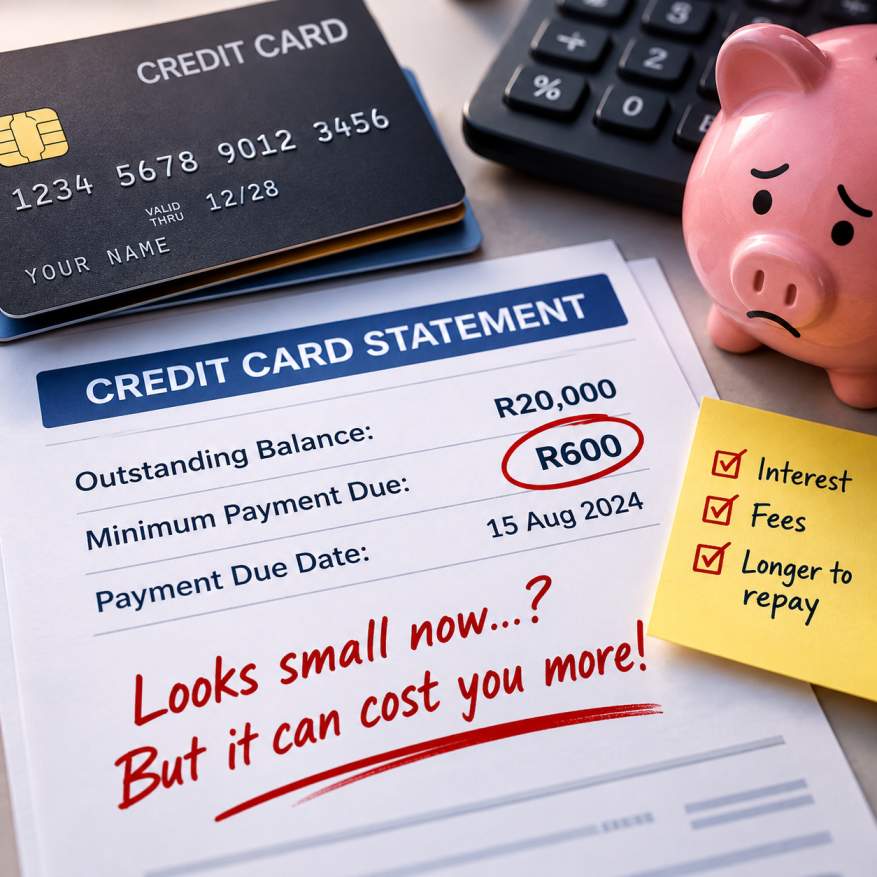
A credit card statement arrives and shows an outstanding balance of R20,000.
Further down the statement, you see something much less intimidating:
Minimum payment due: R600
At first glance, paying R600 instead of R20,000 sounds like a relief.
You make the minimum payment, your account remains up to date, and you move on to the next month’s expenses.
But there is something important that every credit-card user in South Africa should understand:
The minimum payment is not designed to be the fastest or cheapest way to get out of credit-card debt.
It is simply the minimum amount your credit provider requires you to pay under your agreement for that billing period.
If you repeatedly pay only the minimum while carrying a large balance, you could remain in debt for years and pay substantially more interest than someone who pays larger amounts.
The situation can become even worse if you continue using the card while trying to repay it.
This guide explains how credit-card minimum payments work in South Africa, why balances can decrease so slowly, how interest affects your repayments, and what practical steps you can take to get credit-card debt under control.
What Is a Credit Card Minimum Payment?
Your minimum payment is the smallest amount you are required to pay toward your credit-card account for a particular billing period.
The exact calculation depends on your bank and credit-card agreement.
For example, a bank may require a percentage of the outstanding balance, potentially together with applicable interest, fees, budget instalments, overdue amounts or other charges depending on the product.
This means there isn’t one universal minimum-payment percentage that applies to every South African credit card.
As a current real-world example, Standard Bank advertises a 3% minimum monthly repayment on several of its credit-card products. Absa similarly explains that minimum percentages can vary by product and bank, mentioning 3%, 5% or 10%, while stating that its own minimum repayment percentage is 3%. (Standard Bank)
You should therefore check your own statement and credit agreement rather than assuming your minimum will be the same as someone else’s.
Why Do Credit Cards Have Minimum Payments?
A credit card is different from a traditional personal loan.
With a personal loan, you might borrow:
R30,000 over 36 months
and agree to a structured repayment schedule.
A credit card is revolving credit.
If you have a R30,000 limit, you can use some of that money, repay it and then generally use the available credit again.
Because the balance can constantly change, credit cards usually don’t work like a conventional fixed-term loan.
Instead, the credit provider requires a minimum payment.
For example, imagine your statement says:
Outstanding balance: R15,000
Minimum payment: R450
You don’t necessarily need to repay the entire R15,000 immediately.
You need to meet at least the required payment by the due date to comply with the payment requirement on your statement.
But there is a huge difference between:
meeting the minimum payment requirement
and
paying off the debt efficiently.
Paying the Minimum Does Not Mean You’re Paying Only the Money You Borrowed
This is where many people misunderstand credit cards.
Imagine you owe:
R20,000
and pay:
R600.
It might feel as though your debt should immediately become:
R19,400.
But that’s not necessarily what happens.
Interest and applicable fees can also be charged to the account.
Under South Africa’s National Credit Act, permitted costs associated with a credit agreement can include principal debt, initiation fees, service fees, interest, credit insurance and certain default or collection costs where applicable. (NCR)
So part of the money flowing through your account may be dealing with the cost of borrowing, rather than simply reducing what you originally spent.
How Credit Card Interest Works
Credit-card interest is essentially the price you pay for borrowing money.
Your credit provider gives you access to credit and charges interest according to the terms of your agreement.
In South Africa, credit cards fall into the credit facility category under the National Credit Act framework.
The National Credit Regulator publishes prescribed maximum-rate formulas for different categories of consumer credit, including credit facilities such as credit cards and store cards. (NCR)
That does not mean every bank charges the maximum rate.
Your actual contracted interest rate matters.
Depending on your credit card, you may have different interest treatment for:
- Normal purchases
- Cash withdrawals
- Budget transactions
- Fund transfers
- Other specialised transactions
Always read your own pricing guide.
Interest Is Often Calculated Daily
Another important detail is that credit-card interest can be calculated based on your outstanding balance over time rather than simply looking at your balance once at the end of the month.
Standard Bank, for example, explains that interest is usually calculated daily on the outstanding balance and added to the account monthly. (Standard Bank)
This means the size of your balance and how long you carry it both matter.
The longer a large balance remains outstanding, the more opportunity there is for interest to accumulate.
The Interest-Free Period Can Make a Huge Difference
Credit cards can be very useful when you understand their interest-free periods.
Some South African cards offer up to 55 or 57 days interest-free on qualifying purchases, depending on the bank and product.
But the words “up to” are extremely important.
You don’t necessarily get exactly 55 days from every purchase.
Standard Bank explains that its advertised 55-day interest-free period consists of the statement cycle plus the period until the payment due date. To receive the benefit on qualifying purchases, the closing balance shown on the statement must be settled in full by the due date. It also specifically notes that the interest-free period does not apply to cash transactions. (Standard Bank)
Absa similarly explains that different transaction types can attract interest from the transaction date. (Absa)
So don’t assume:
“My credit card says 55 days interest-free, therefore I can pay only the minimum and never pay interest.”
Those are two completely different concepts.
Paying in Full vs Paying the Minimum
This is arguably the most important distinction in this article.
Suppose your statement balance is:
R10,000
and your required minimum is:
R300
Option 1: Pay R10,000
If the R10,000 consists entirely of qualifying purchases and you’ve met all the conditions of your card’s interest-free facility, settling the statement balance in full by the due date may allow you to avoid purchase interest for that cycle.
Option 2: Pay R300
You have met the minimum payment requirement, but you are still carrying most of the balance.
The remaining debt can attract interest according to your credit agreement.
The difference becomes substantial when this happens month after month.
Why Minimum Payments Can Feel So Attractive
Most people don’t intentionally decide:
“I want to remain in credit-card debt for years.”
It usually happens gradually.
Imagine you owe R20,000.
Your bank isn’t demanding R20,000 this month.
It asks for a much smaller payment.
You think:
“R600 isn’t too bad.”
You pay R600.
Next month you do the same.
You feel responsible because you haven’t missed a payment.
And to be clear:
Paying the minimum on time is far better than simply ignoring the payment.
TransUnion specifically advises consumers to pay at least the minimum amount every month and notes that late payments can negatively affect credit scores. (TransUnion South Africa)
The problem is when “minimum” becomes your long-term repayment strategy.
A Simple R10,000 Example
Let’s illustrate why.
Assume:
Starting credit-card balance: R10,000
Illustrative annual interest rate: 20%
No new purchases
No additional fees included
For a simplified monthly illustration, 20% annually is approximately 1.667% per month.
In the first month, approximate interest would be:
R10,000 × 1.667% = R166.70
Suppose you pay:
R300
Only approximately:
R133.30
of that payment has reduced the balance after the illustrative interest.
Your approximate balance becomes:
R9,866.70
You paid R300.
But your debt fell by only around R133.
That is why minimum-payment debt can feel frustratingly slow.
Now Compare a R1,000 Payment
Same situation:
Balance: R10,000
Illustrative annual interest: 20%
Approximate first-month interest:
R166.70
But now you pay:
R1,000
Approximately:
R833.30
goes toward reducing the balance after that illustrative interest.
The debt begins falling much faster.
The interest charged next month also has a smaller balance to work against.
That’s where the snowball effect starts working in your favour.
Illustrative Chart: How Much of the First Payment Reduces the Balance?
Using the simplified R10,000 balance at 20% annually:
| Monthly Payment | Approx. First-Month Interest | Approx. Balance Reduction |
|---|---|---|
| R300 | R167 | R133 |
| R500 | R167 | R333 |
| R750 | R167 | R583 |
| R1,000 | R167 | R833 |
| R2,000 | R167 | R1,833 |
This is only an educational illustration. Actual credit-card interest can be calculated daily and fees and transactions can change the result.
But the lesson is clear:
The larger your repayment above the interest and charges, the faster the actual debt falls.
What Happens With a R5,000 Credit Card Balance?
Let’s use another simplified example.
Assume:
Balance: R5,000
Annual interest: 20%
No new spending
No fees
If you paid a fixed R500 per month, the debt would fall considerably faster than if you repeatedly paid a very small amount.
The first month’s approximate interest would be:
R83
so around:
R417
of your R500 payment would reduce the principal balance.
As the balance decreases, the approximate interest amount also decreases.
Eventually, more and more of the R500 payment works against the actual debt.
What About a R25,000 Balance?
Now the problem becomes easier to see.
Assume:
Balance: R25,000
Illustrative annual interest: 20%
Approximate first-month interest:
R417
If your payment were only:
R750
then only around:
R333
would initially reduce the balance after the simplified interest calculation.
But if you paid:
R2,500
approximately:
R2,083
would initially reduce the balance.
Same debt.
Same illustrative rate.
Completely different repayment speed.
Why a Percentage-Based Minimum Can Keep Shrinking
There’s another important feature of some minimum-payment structures.
Suppose your minimum is calculated as a percentage of the balance.
As your balance falls, the minimum payment may also fall.
For a simplified 3% example:
R20,000 balance → R600
R15,000 balance → R450
R10,000 balance → R300
R5,000 balance → R150
Again, real minimum-payment formulas can include other components, so these numbers are illustrative.
But notice the problem.
If you always reduce your payment simply because the required minimum becomes smaller, you also reduce the amount you’re throwing at the debt.
This can stretch the repayment considerably.
A Better Strategy: Keep Your Payment Fixed
Suppose your initial minimum payment is R600.
Instead of allowing your repayment to decline as the balance falls, you decide:
“I’m paying at least R1,500 every month until this card is cleared.”
As the balance decreases, the interest cost generally decreases too.
But your R1,500 payment stays the same.
That means progressively more of your payment can attack the principal.
This is one of the simplest ways to accelerate credit-card repayment.
Illustrative Repayment Comparison
Consider a R20,000 balance at an illustrative 20% annual rate, with no additional purchases or fees.
Rather than attempting to model a particular bank’s minimum-payment formula, compare fixed monthly repayments:
| Fixed Monthly Payment | Approximate Time to Repay | Approximate Interest Paid |
|---|---|---|
| R500 | ~67 months | ~R13,100 |
| R750 | ~36 months | ~R6,400 |
| R1,000 | ~25 months | ~R4,500 |
| R1,500 | ~16 months | ~R2,800 |
| R2,000 | ~11 months | ~R2,000 |
These are simplified educational estimates using monthly compounding, excluding card fees and additional transactions. They are not quotations or predictions for any particular South African credit card.
But look at the difference between R500 and R1,500.
Increasing the monthly repayment by R1,000 can potentially cut years from the repayment period in this illustration.
The chart makes the central point visible:
Small increases in repayment can make a very large difference to how long the debt remains with you.
The Real Danger: Continuing to Use the Card
Everything we’ve calculated so far assumes:
No new purchases.
Real life often looks very different.
Suppose you owe:
R15,000
and pay:
R1,000.
Great.
Then you buy:
R700 groceries
and:
R400 petrol
on the card.
You’ve added:
R1,100
in new spending.
Before even considering interest and fees, you’ve spent more than you repaid.
Your balance can actually increase even though you made a R1,000 payment.
This is how people end up saying:
“I pay my credit card every month, but it never goes down.”
The problem may not be the payment.
The problem may be that new spending is replacing everything being repaid.
Example: The Credit Card Treadmill
Consider this simplified month:
Opening balance: R18,000
You pay:
R1,500
You then use the card for:
Groceries: R800
Fuel: R600
Takeaway: R250
Online purchase: R450
New spending:
R2,100
Before interest and fees, you’ve already added R600 more than you paid.
Your debt hasn’t decreased.
It has increased.
Repeat this every month and minimum payments won’t solve the problem.
The Minimum Payment Is a Floor, Not a Target
This is probably the easiest rule to remember:
Treat the minimum payment as the minimum acceptable amount — not the amount you should automatically aim to pay.
If your statement says:
Minimum due: R600
and you can responsibly afford:
R1,500
you generally don’t gain anything by deliberately paying only R600 and carrying the extra debt longer.
Paying more reduces the outstanding balance faster.
A smaller balance generally means less future interest.
Less interest means more of your next payment can attack the balance.
It’s a positive cycle.
Minimum Payment vs Full Statement Balance
Credit-card users should learn the difference between three numbers:
1. Current balance
What you currently owe, including transactions that may have occurred after your latest statement.
2. Statement balance
The amount reflected when your billing cycle closed.
3. Minimum payment
The minimum amount required for that payment cycle.
These numbers can be very different.
For example:
Current balance: R13,500
Statement balance: R10,000
Minimum due: R300
If you blindly see R300 and think:
“That’s what I owe this month.”
you’re misunderstanding the statement.
R300 is the required minimum.
The R10,000 statement balance is a completely different number.
Why Paying the Full Statement Balance Can Be Powerful
For consumers who use their credit card mainly as a payment tool rather than long-term borrowing, paying the qualifying statement balance in full can be an effective strategy.
Some cards provide an interest-free purchase period when the required conditions are met.
For example, Standard Bank currently advertises up to 55 days interest-free when the applicable balance is settled in full under its terms. (Standard Bank)
Someone might therefore use a card to:
Buy groceries.
Pay online.
Buy fuel where qualifying.
Earn applicable rewards.
Then settle the qualifying statement balance completely.
That behaviour is fundamentally different from someone who spends R20,000 and then carries that balance for several years.
The same piece of plastic can represent two completely different financial behaviours.
Don’t Assume Every Transaction Gets an Interest-Free Period
This deserves its own section because it’s a common mistake.
Your credit card’s advertised interest-free period may apply to qualifying purchases but not to every type of transaction.
Cash withdrawals are a major example.
Standard Bank explicitly states that its 55-day interest-free period doesn’t apply to cash transactions. (Standard Bank)
Absa lists several transaction categories where interest can be charged from the transaction date, including cash withdrawals and certain transfers and budget transactions. (Absa)
Always check your bank’s current pricing guide.
Don’t withdraw R10,000 from your credit card and simply assume:
“I’ve got 55 days before this costs me anything.”
Your product terms may say otherwise.
What Happens If You Miss the Minimum Payment?
Paying only the minimum can be expensive.
But not paying the required minimum at all can be worse.
A missed payment can put your account into arrears.
Depending on the circumstances, consequences can include:
- Late or default-related charges where permitted
- Negative payment information
- Collection activity
- Difficulty obtaining future credit
- Legal processes if the default continues
TransUnion identifies payment history as a major credit-score factor and says late payments can lower your score. (TransUnion South Africa)
So if you’re deciding between:
Paying nothing
and:
Paying the required minimum
paying the minimum on time is clearly preferable.
The argument in this article isn’t:
“Don’t pay the minimum.”
It’s:
“Don’t pay only the minimum when you can sustainably pay more.”
How Minimum Payments Can Affect Your Credit Score
Paying the minimum on time can help you avoid recording a missed payment.
But that’s not the entire credit-score picture.
Credit utilisation matters too.
Credit utilisation describes how much of your available revolving credit you’re using.
For example:
Credit limit: R20,000
Balance: R18,000
You’re using:
90% of the limit.
TransUnion says high account balances can negatively affect a consumer’s credit score and advises keeping credit-card balances below 35% of the available limit, noting that balances above roughly 35–50% can begin affecting its scoring. (TransUnion South Africa)
This isn’t a universal law that guarantees a particular score change at exactly 35%.
Credit scoring is more complicated than that.
But it demonstrates why paying only the minimum on a nearly maxed-out card may not be ideal even if every payment is technically made on time.
Example: R30,000 Credit Limit
Suppose your limit is:
R30,000
Here’s what different balances look like:
| Outstanding Balance | Credit Used |
|---|---|
| R3,000 | 10% |
| R9,000 | 30% |
| R15,000 | 50% |
| R24,000 | 80% |
| R30,000 | 100% |
A card sitting constantly near R30,000 leaves you with very little financial flexibility.
If your car suddenly needs a R7,000 repair, there is almost no available credit left.
That is another reason to reduce high balances rather than treating minimum payments as a permanent solution.
Should You Increase Your Credit Limit to Improve Utilisation?
Be careful with this idea.
Mathematically, increasing your limit can lower your utilisation percentage if your balance stays unchanged.
For example:
Balance: R10,000
Limit: R20,000
Utilisation: 50%
Increase the limit to:
R40,000
and the same R10,000 represents:
25%.
But this isn’t automatically a good financial strategy.
If the extra R20,000 of available credit tempts you to spend more, you haven’t solved anything.
You may eventually have:
R30,000 balance on a R40,000 limit
instead of:
R10,000 on a R20,000 limit.
Reducing actual debt is generally more meaningful than playing games with percentages.
How Fees Affect Minimum-Payment Debt
Interest isn’t the only cost to consider.
Credit cards can have charges such as:
- Monthly card fees
- Service fees
- Initiation fees
- Cash withdrawal fees
- Foreign transaction charges
- Other product-specific fees
Under the National Credit Act, the types of credit costs providers may charge are regulated. (NCR)
But even a permitted recurring fee matters when you’re carrying debt for years.
Imagine your card costs:
R60 per month
and you remain in debt for:
48 months.
That’s:
R2,880
in monthly fees over that period, before considering interest or other charges.
Your actual product may charge more or less.
This is why comparing cards based only on the advertised interest rate can be misleading.
R5,000 vs R10,000 vs R25,000: Why Balance Size Matters
Let’s compare three balances at the same illustrative 20% annual interest rate.
Approximate first-month interest:
| Balance | Approx. Monthly Interest at 20% p.a.* |
|---|---|
| R5,000 | R83 |
| R10,000 | R167 |
| R25,000 | R417 |
*Simplified calculation using 20% ÷ 12. Actual cards may calculate interest daily.
This shows why large balances are harder to attack.
Someone paying R500 toward a R5,000 balance has much more repayment power relative to the debt than someone paying R500 toward R25,000.
With R25,000 outstanding, most of that R500 could initially be absorbed by interest in this simplified example.
The Snowball Can Work Against You
Compound interest is often discussed in the context of investing.
You invest money.
Returns are added.
Those returns potentially generate further returns.
Debt can produce an unpleasant version of the same effect.
If interest and charges are added while the debt isn’t being reduced sufficiently, your repayment progress can become extremely slow.
And if you add new purchases, the problem becomes worse.
You aren’t only fighting yesterday’s spending.
You’re fighting:
Yesterday’s spending + borrowing costs + today’s spending.
How to Escape the Minimum-Payment Cycle
If you’ve been paying the minimum for months or years, don’t panic.
Start with the numbers.
Step 1: Stop adding unnecessary purchases
If possible, temporarily stop using the card for discretionary spending while you reduce the balance.
That doesn’t necessarily mean closing the account.
It means preventing new spending from cancelling your repayment progress.
Step 2: Find your actual interest rate
Check your statement, banking app or credit agreement.
Don’t guess.
Step 3: Find your current balance
Write down the exact amount.
For example:
R18,742
Seeing the actual number is better than saying:
“I owe around twenty grand.”
Step 4: Check your minimum payment
You still need to meet the required minimum.
Step 5: Decide on a fixed repayment above the minimum
Perhaps your minimum is R560.
After reviewing your budget, you realise you can afford:
R1,200
Set that as your repayment target.
Step 6: Automate it if appropriate
A debit order or scheduled payment can reduce the chance of forgetting.
Step 7: Put extra money toward the balance
A bonus, tax refund or other genuine surplus could potentially accelerate repayment.
Don’t leave yourself without emergency cash, but consider whether some unexpected income can reduce expensive revolving debt.
Don’t Empty Your Emergency Fund Without Thinking
Suppose you have:
R20,000 credit-card debt
and:
R10,000 emergency savings.
Should you immediately use the entire R10,000 to pay the card?
Not necessarily.
Mathematically, reducing expensive debt can make sense.
But if you leave yourself with:
R0 emergency savings
and your car breaks tomorrow, you might simply put the repair back onto the credit card.
You haven’t permanently solved the problem.
A balanced approach may involve maintaining an appropriate emergency buffer while aggressively reducing debt.
Your circumstances matter.
The Debt Avalanche Method
If you have multiple debts, one strategy is the debt avalanche.
You:
- Make the required payments on all debts.
- Identify the debt with the highest effective interest cost.
- Put extra repayment money toward that debt.
- Once it’s cleared, move that money to the next expensive debt.
Example:
Credit Card A: R15,000 at 22%
Credit Card B: R8,000 at 18%
Personal Loan: R30,000 at 15%
Assuming other costs don’t change the ranking, you’d focus extra money on Card A first while keeping the other required payments current.
The advantage is mathematical:
You’re attacking the most expensive interest first.
The Debt Snowball Method
Another strategy is the debt snowball.
Instead of focusing on the highest rate, you focus on the smallest balance.
Example:
Store account: R2,000
Credit card: R12,000
Personal loan: R30,000
You attack the R2,000 balance first.
Once it’s cleared, you take the money you were paying toward it and add it to the credit-card repayment.
The snowball isn’t necessarily the mathematically cheapest method.
Its advantage is psychological.
Clearing one debt quickly can give people motivation to continue.
The best repayment strategy is one you can realistically maintain.
Should You Take a Personal Loan to Pay Off Your Credit Card?
Sometimes people consider consolidating expensive revolving debt into a personal loan.
This can potentially make sense if:
- The new borrowing cost is genuinely lower
- Fees don’t erase the savings
- The repayment is affordable
- The term isn’t unnecessarily long
- You stop rebuilding the credit-card balance
That final point is crucial.
Imagine:
Credit-card debt: R30,000
You take:
R30,000 personal loan
and settle the card.
Your credit card now has R30,000 available again.
Six months later you’ve spent:
R15,000
on it.
Now you have:
Personal loan + new credit-card debt.
You didn’t consolidate your debt.
You multiplied it.
Always compare the total cost, not merely the new monthly payment.
A Lower Monthly Payment Isn’t Always a Better Deal
Suppose you currently pay:
R1,500
toward a credit card.
A lender offers consolidation with a repayment of:
R850 per month.
Sounds great.
But perhaps the new loan lasts:
60 months.
The lower monthly payment may simply mean you’ve stretched the debt across a much longer period.
Ask:
How much will I repay altogether?
That’s the number people often forget to compare.
What If You Can Only Afford the Minimum?
Sometimes paying more simply isn’t possible.
Your salary may be under pressure from:
- Rent
- Food
- Electricity
- Transport
- Children
- Medical expenses
- Other debt
If you can only afford the minimum this month, paying it is better than missing the payment.
But if you can only ever afford minimum payments, particularly across several maxed-out credit facilities, that’s a warning sign.
The problem may no longer be:
“How do I pay my card faster?”
It may be:
“Is my household over-indebted?”
Don’t solve that by taking random additional loans.
What If You Can’t Make the Minimum Payment?
Contact the credit provider as early as possible.
Don’t wait for several missed payments before acknowledging the problem.
Explain your circumstances and ask what legitimate options are available.
If your overall debt has become unmanageable, South Africa has a formal debt counselling/debt review process under the National Credit Act for qualifying over-indebted consumers.
The National Credit Regulator provides information about consumer credit, registered credit providers and debt counsellors.
Be cautious about unverified companies promising to:
“Erase your debt instantly”
or:
“Remove your name from credit bureaus overnight.”
Use registered and verifiable providers.
Never Ignore Your Credit-Card Statements
Your statement contains valuable information.
Check:
Opening balance
Purchases
Payments
Interest charged
Fees
Minimum payment
Payment due date
Closing balance
and:
Available credit.
If you notice a transaction you don’t recognise, investigate it promptly through your bank’s official channels.
Also check whether your balance is actually decreasing from month to month.
If you’ve paid R1,000 every month for six months but the balance barely changed, determine why.
Perhaps:
- You’re continuing to spend
- Interest is high
- Fees are significant
- Your repayments are too small relative to the balance
The statement tells the story.
A Simple Credit-Card Repayment Worksheet
You can create a basic table like this:
| Month | Opening Balance | Payment | New Spending | Interest & Fees | Closing Balance |
|---|---|---|---|---|---|
| January | R20,000 | R1,500 | R0 | R400 | R18,900 |
| February | R18,900 | R1,500 | R0 | R370 | R17,770 |
| March | R17,770 | R1,500 | R0 | R350 | R16,620 |
These numbers are illustrative.
But keeping your own real table can be surprisingly motivating.
Instead of thinking:
“I have this massive credit-card problem.”
you start thinking:
“I was at R20,000. I’m now at R16,620.”
Progress becomes visible.
Create a “No New Debt” Challenge
If you’re serious about paying off a card, try a temporary rule:
For the next 90 days, no discretionary purchases go onto the credit card.
Use your normal income for:
- Groceries
- Transport
- Entertainment
- Clothing
- Takeaways
while directing a predetermined amount toward the card.
This separates:
repayment
from:
new spending.
Without that separation, it can be difficult to know whether you’re making progress.
What Happens When the Card Reaches Zero?
This is where many people make another mistake.
They finally pay off:
R25,000
and suddenly see:
Available credit: R25,000
That R25,000 can feel like money.
It isn’t.
It’s borrowing capacity.
You don’t suddenly have R25,000.
You have permission to potentially owe R25,000 again.
That mental distinction is extremely important.
Should You Close the Card Once It’s Paid Off?
Not necessarily.
A responsibly managed credit card can form part of your credit history, and closing accounts can have implications for available credit and your overall credit profile.
But financial behaviour matters more than chasing theoretical optimisation.
If having R50,000 of available credit causes you to repeatedly spend R50,000, keeping the account purely because you think it might help your credit score may not be sensible.
You could consider whether a lower limit is more appropriate.
TransUnion notes that both account balances and the amount of available credit can influence its scoring assessments. (TransUnion South Africa)
How to Use a Credit Card Without Living in Credit-Card Debt
A useful approach is to treat the card as a payment method, not additional income.
Suppose your monthly grocery budget is:
R5,000.
You might pay for groceries using the credit card for convenience or rewards.
But you should already have the R5,000 available in your budget.
When the statement comes, you settle the qualifying balance according to your plan.
That’s completely different from:
“I have no grocery money left, but there’s R5,000 available on my credit card.”
In the second situation, credit is replacing income.
If that happens repeatedly, debt can accumulate rapidly.
Don’t Spend Based on Your Credit Limit
If your bank gives you a:
R80,000 credit limit
that doesn’t mean:
“I can afford R80,000.”
Your limit represents the maximum credit available under the facility, subject to the agreement.
Affordability should come from your budget.
Imagine someone earning:
R20,000 per month
with a:
R60,000 credit limit.
Spending the full R60,000 could leave them owing three months of gross income before considering normal living expenses.
The limit isn’t a spending recommendation.
How to Choose Your Own Monthly Repayment Target
Instead of asking:
“What’s the minimum?”
ask:
“What’s the most I can sustainably pay without needing to borrow the money back?”
Suppose your budget looks like this:
Net income: R24,000
Essential expenses: R17,000
Other debt payments: R3,000
Savings/emergency allocation: R1,000
Remaining:
R3,000
You might decide to put:
R2,000
toward the credit card and retain:
R1,000
as additional breathing room.
The exact numbers will differ for every household.
The important thing is that the repayment is both:
aggressive enough to reduce debt
and:
realistic enough to maintain.
Increase the Payment When Your Income Increases
Suppose you were paying:
R1,000 per month
toward your card.
Then you receive a salary increase of:
R1,500 per month.
Instead of allowing your lifestyle expenses to absorb the entire increase, you could temporarily raise the card repayment to:
R2,000
or:
R2,500.
Once the card is settled, that extra monthly cash flow becomes yours again.
Use Windfalls Carefully
You receive:
R8,000 tax refund
or:
R10,000 bonus.
You owe:
R20,000 on your credit card.
Using part of that windfall to reduce the balance could potentially save future interest.
But balance this against genuine short-term needs and emergency savings.
The goal isn’t to pay R10,000 into the card today and then borrow R10,000 again next month because you left yourself with no cash.
Credit Card Minimum Payment Myths
“If I pay the minimum, I don’t pay interest.”
False.
The minimum payment and interest-free conditions are separate issues.
“The bank wouldn’t set the minimum that low if it wasn’t a good repayment amount.”
The minimum tells you what you must pay under the agreement for that billing period. It doesn’t mean it is the cheapest repayment strategy.
“My balance will eventually disappear if I keep paying the minimum.”
It can decrease if you’re making sufficient payments and not adding debt, but the process may be very slow depending on your card’s terms and payment formula.
“I have R20,000 available, so I have R20,000.”
No.
You have access to R20,000 of potential debt.
“If I pay the minimum, my credit score will automatically be excellent.”
Not necessarily.
Payment history matters, but so do factors such as outstanding balances, utilisation and other credit-profile information. (TransUnion South Africa)
10 Frequently Asked Questions About Credit Card Minimum Payments
1. What is the minimum payment on a credit card in South Africa?
It depends on the bank, product and credit agreement.
Some South African cards use a percentage of the outstanding balance. For example, Standard Bank currently advertises a 3% minimum monthly repayment on several cards, while Absa says its minimum repayment percentage is 3%. (Standard Bank)
Check your own statement for the exact amount required.
2. Is it bad to pay only the minimum on my credit card?
Paying the minimum on time is better than missing the payment.
However, repeatedly paying only a small minimum can make repayment take much longer and increase the amount of interest you pay.
If you can sustainably afford more, paying above the minimum can accelerate repayment.
3. Do I pay interest if I make the minimum payment?
Potentially, yes.
Paying the minimum doesn’t automatically qualify you for an interest-free period.
Your interest treatment depends on the type of transaction, whether the applicable statement balance was settled and the conditions of your credit-card agreement.
4. How can I avoid paying credit-card interest?
Some credit cards provide an interest-free period on qualifying purchases if the required balance is settled in full by the applicable due date.
Check your specific card’s terms because cash withdrawals and certain other transactions may not qualify.
5. What happens if I pay more than the minimum?
The additional payment can help reduce your outstanding balance faster, which can reduce future interest costs.
Provided you’re not replacing the repayment with new spending, consistently paying above the minimum can substantially shorten your debt-repayment period.
6. Should I pay my entire credit-card balance every month?
If you can afford to settle the applicable statement balance in full without compromising essential expenses, doing so can help avoid carrying expensive revolving debt and may allow qualifying purchases to benefit from the card’s interest-free conditions.
Always check your specific agreement.
7. What happens if I miss the minimum payment?
Your account can fall into arrears.
Depending on the circumstances, you could face applicable default-related charges, negative credit information and eventually collection or legal action.
If you cannot make the required payment, contact your credit provider promptly.
8. Can minimum payments hurt my credit score?
Making the minimum payment on time helps you avoid a missed payment, which is important.
However, if you’re carrying a very high balance relative to your credit limit, credit utilisation can also affect your credit profile. TransUnion identifies both payment history and credit utilisation as credit-score factors. (TransUnion South Africa)
9. Should I take another loan to settle my credit card?
Not automatically.
Debt consolidation can make sense if the new loan genuinely has a lower total cost and an affordable repayment structure.
But don’t compare only monthly instalments.
Compare interest, fees, term and total repayment, and make sure you won’t simply rebuild the credit-card balance afterward.
10. What’s the fastest way to pay off a credit card?
There isn’t one method that works for everyone, but the basic strategy is straightforward:
Stop unnecessary new card spending, keep all required payments current, choose a fixed repayment significantly above the minimum where affordable, and direct extra available money toward the balance.
The larger the sustainable repayment, the faster the principal can fall.
Final Thoughts: Don’t Let “Minimum” Become Your Financial Goal
Credit-card minimum payments serve an important purpose.
They give consumers flexibility.
If you have an unusually expensive month, you don’t necessarily have to settle the entire credit-card balance immediately.
But flexibility comes at a price when short-term borrowing becomes long-term debt.
A minimum payment of:
R300
can make a:
R10,000 balance
feel manageable.
A payment of:
R600
can make:
R20,000
feel less frightening.
But the number you should really focus on isn’t the minimum payment.
It’s the:
outstanding balance.
Ask yourself:
Is my balance lower than it was three months ago?
If the answer is yes, you’re moving in the right direction.
If you’ve made three payments and the balance is higher, investigate why.
Look at:
Interest.
Fees.
New purchases.
Cash withdrawals.
Your repayment amount.
A credit card can be an extremely convenient financial tool when used responsibly. It can provide payment flexibility, help with certain short-term purchases and contribute to a credit history.
But a credit limit is not income.
And a minimum payment is not necessarily a good long-term debt-repayment plan.
If you owe R20,000 and your statement says the minimum is R600, don’t automatically ask:
“Can I afford the R600?”
Also ask:
“How much more than R600 can I sustainably pay so that this R20,000 actually starts disappearing?”
That change in thinking can make a significant difference.
The goal shouldn’t simply be to survive another statement.
The goal should be to reach a point where the statement says:
Balance: R0.00
For more information about South African consumer-credit regulation and your rights under the National Credit Act, visit the National Credit Regulator. For educational information about credit reports, payment history and credit utilisation, visit TransUnion South Africa.
Disclaimer: This article is for general educational purposes and does not constitute personalised financial, legal, credit or debt-counselling advice. The repayment calculations are simplified illustrations and do not represent a quotation from any bank. Actual credit-card interest may be calculated daily, and interest rates, minimum-payment formulas, fees, insurance, transaction types and interest-free conditions vary between credit providers and products. Check your own credit agreement and current pricing guide before making financial decisions.
| payment | months |
|---|---|
| R500 | 67 |
| R750 | 36 |
| R1,000 | 25 |
| R1,500 | 16 |
| R2,000 | 11 |