For many South Africans, investing sounds like something you do once you have a high-paying job, a paid-off house and thousands of rand sitting in your bank account.
You might think:
“What’s the point of investing R200? That’s not going to make me rich.”
Or:
“I’ll start investing when I can afford R5,000 a month.”
The problem with waiting is that five years can pass remarkably quickly.
You don’t necessarily need thousands of rand to start investing. The Johannesburg Stock Exchange (JSE) itself says that needing lots of money to begin is a myth and points to lower-cost investment options and diversification as ways ordinary investors can get started. (JSE)
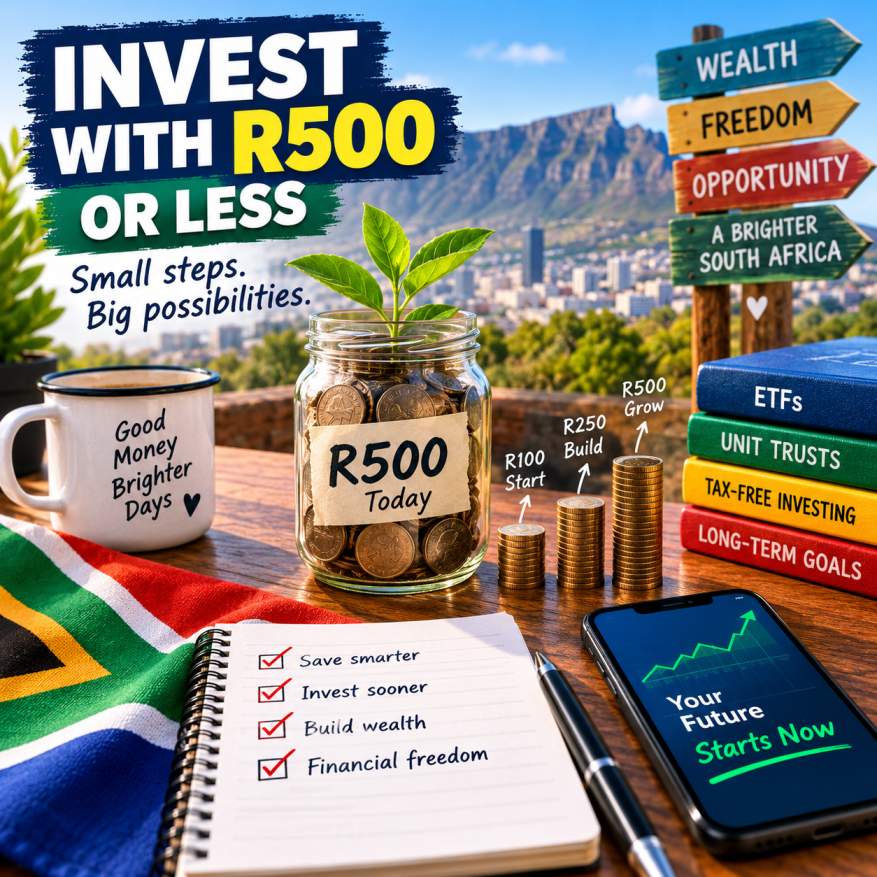
Even R100, R250 or R500 a month can be a meaningful starting point.
Will R500 turn into R1 million next year?
No.
That’s not what sensible long-term investing is about.
The real power comes from combining three things:
Money + time + consistency.
This guide explains how a beginner in South Africa can start investing with R500 or less, what investments are available, how ETFs and Tax-Free Savings Accounts work, what fees to watch, and how small monthly contributions could potentially grow over many years.
Most importantly, we’re going to keep the numbers realistic.
First: What Does Investing Actually Mean?
Saving and investing aren’t exactly the same thing.
When you save, your main objective is usually to preserve money for something you may need relatively soon.
Examples include:
- An emergency fund
- December expenses
- School uniforms
- A car repair
- A deposit
- A holiday
When you invest, you’re generally putting money into assets with the intention of growing your wealth over a longer period.
These could include:
- Shares
- Exchange-Traded Funds (ETFs)
- Unit trusts
- Bonds
- Property-related investments
- Money-market investments
- Retirement funds
The important difference is that investments can fluctuate in value.
If you invest R500 today, nobody can guarantee that it will be worth R510 next month.
It could be:
R520
or:
R470.
Over longer periods, growth-oriented investments are generally chosen because investors hope their returns will outperform simply leaving the money as cash.
But returns are never guaranteed.
Can You Really Start Investing With R500?
Yes.
And depending on the investment platform and product, you may be able to start with considerably less.
The JSE describes micro-investing as a way for ordinary people to access financial markets using low minimum deposits and, on some platforms, fractional investing. It also notes that investors can access JSE investments through authorised brokers, investment plans and financial-services providers. (JSE)
This has changed investing significantly.
Years ago, buying a diversified portfolio of individual shares could require substantial capital.
Today, a beginner might invest a few hundred rand into an ETF that itself holds exposure to dozens or even hundreds of companies.
That brings us to one of the most useful investments for beginners.
What Is an ETF?
An Exchange-Traded Fund, or ETF, is essentially an investment fund that can hold a collection of assets.
Instead of using your R500 to buy one company’s shares, an ETF can potentially give you exposure to many companies through a single investment.
The JSE describes ETFs as listed products that can track baskets of shares, bonds or commodities. ETFs trade similarly to ordinary shares and can provide diversification through one product. (JSE)
Imagine an ETF contains exposure to:
Company A
Company B
Company C
Company D
Company E
Company F
Company G
Company H
Your investment isn’t dependent on only one company performing well.
That’s diversification.
Why Diversification Matters
Suppose you have:
R500
and put the entire amount into one company’s shares.
If that company performs extremely well, great.
But what happens if it runs into serious problems?
Your entire R500 is exposed to that one business.
Now imagine investing in a broad ETF containing many businesses across multiple industries.
One company might fall.
Another could rise.
Another may pay dividends.
Another might barely move.
You’re spreading your risk rather than betting everything on one company.
The JSE identifies diversification as one of the major characteristics of ETFs and notes that spreading exposure across underlying investments reduces reliance on a single asset. (JSE)
Diversification doesn’t remove investment risk.
It simply avoids concentrating all your risk in one place.
You Don’t Need to Pick the “Next Big Share”
This is where beginners often get caught.
Someone on social media says:
“This share is going to explode!”
Another says:
“Buy this now before everyone finds out!”
Suddenly you’re trying to turn R500 into R50,000.
That’s speculation, not a sensible beginner investment plan.
There is nothing wrong with eventually learning how to analyse individual companies if that interests you.
But you don’t have to become a professional stock picker to start investing.
A diversified ETF can give you broad exposure without requiring you to analyse every company’s:
- Revenue
- Debt
- Profit margins
- Management
- Competitors
- Valuation
- Financial statements
The JSE specifically describes ETFs as potentially suitable starting vehicles for newer investors because they can provide diversified market exposure through a single listed product. (JSE)
What Can R500 Actually Buy?
Let’s say you’ve decided:
“Every payday, I’m investing R500.”
Your choices might include putting the money into:
A diversified ETF
A unit trust
A Tax-Free Savings Account containing investments
A money-market or interest-bearing investment
or potentially:
Individual shares
depending on your objectives and platform.
The right choice depends on one very important question.
When Will You Need the Money?
Before choosing an investment, ask:
“What am I investing this money for?”
This question matters more than finding the hottest investment.
Money needed within a year
If you’re saving R500 monthly because you need the money for school fees in January, putting it into a volatile equity investment may not be sensible.
You don’t want the stock market to fall 15% one month before you need the money.
Cash or an appropriate short-term savings product may make more sense.
Money needed in three years
You may still want to be relatively cautious depending on how important the goal is.
Money for 10–20+ years
Now you have much more time to ride through market ups and downs.
A diversified growth-oriented investment may become more appropriate.
Your time horizon should influence how much risk you take.
Don’t Invest Your Emergency Money in the Stock Market
Imagine you’ve saved:
R3,000
and that’s every rand you have available.
Then you invest all R3,000 into shares.
Two weeks later your car needs a:
R2,500 repair.
You now need to sell investments whether the market is up or down.
That’s not ideal.
Before aggressively investing for the long term, consider building an emergency fund.
Your emergency savings should generally be somewhere accessible and appropriate for short-notice expenses.
Think:
Car repairs
Medical expenses
Urgent travel
Unexpected household costs
Temporary income loss
Your long-term investments should ideally be money you don’t expect to need next week.
What If I Have Debt?
This deserves serious consideration.
Suppose you have:
R10,000 credit-card debt at a high interest rate
and:
R500 extra each month.
Should you invest the R500 or use it to reduce the credit card?
Paying down expensive debt can effectively provide a powerful financial benefit because reducing the balance reduces future interest costs.
For example, hoping your investment earns 8% while you’re paying 20%+ on revolving debt may not make financial sense.
That doesn’t mean everyone with debt must stop investing.
A home loan at one rate is very different from expensive short-term debt.
But before investing, list your debts and their costs.
Sometimes the best first “investment” is reducing expensive debt.
Starting With R100
You don’t even have to start at R500.
Suppose money is tight.
You decide:
R100 per month.
That’s:
R1,200 per year.
It doesn’t sound life-changing.
But something important has happened:
You’ve become an investor.
You’ve created the habit.
When your income improves, you might increase it to:
R150
then:
R250
then:
R500
and eventually:
R1,000.
Starting is often harder than increasing later.
Starting With R250
R250 per month equals:
R3,000 per year.
That’s approximately:
R8.22 per day.
Many people unintentionally spend that much on small purchases without thinking about it.
Again, investing doesn’t mean you shouldn’t enjoy your money.
The point is that building wealth doesn’t always require a dramatic lifestyle change.
Sometimes it starts with redirecting a relatively small amount consistently.
Starting With R500
R500 per month equals:
R6,000 per year.
Over:
10 years
your own contributions alone would total:
R60,000.
Over:
20 years: R120,000.
Over:
30 years: R180,000.
And that’s before considering any investment growth.
This is where compounding becomes interesting.
What Is Compound Growth?
Compounding happens when returns remain invested and can potentially generate further returns.
Suppose you invest:
R10,000
and hypothetically earn:
8%.
After one year:
R10,800
If that entire amount remains invested and earns another 8%, you’re now earning a return not only on your original R10,000 but also on the previous growth.
Over long periods, that can become powerful.
But remember:
Real investments don’t produce exactly 8% every year.
One year might be positive.
Another might be negative.
Another could produce strong growth.
The examples below use a constant hypothetical return simply to demonstrate the mathematics.
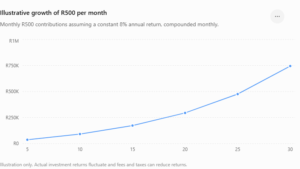
What Could R500 Per Month Become?
Let’s assume:
Monthly contribution: R500
Illustrative annual return: 8%
Contributions made monthly
Returns reinvested
Fees and taxes ignored for simplicity
Approximate results:
| Time Invested | Your Contributions | Illustrative Value |
|---|---|---|
| 5 years | R30,000 | ~R36,700 |
| 10 years | R60,000 | ~R91,500 |
| 20 years | R120,000 | ~R294,500 |
| 30 years | R180,000 | ~R745,000 |
These figures are illustrations, not forecasts or guaranteed returns.
But notice something interesting.
After 30 years you personally contributed:
R180,000
while the hypothetical account is worth around:
R745,000.
The difference comes from assumed investment growth and compounding.
That’s why starting early can matter so much.
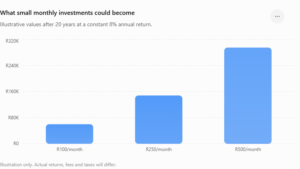
R100 vs R250 vs R500 Per Month
Now let’s compare three investors.
Each invests for 20 years.
We’ll again assume a hypothetical constant:
8% annual return
| Monthly Amount | Total Contributed | Illustrative Value After 20 Years |
|---|---|---|
| R100 | R24,000 | ~R58,900 |
| R250 | R60,000 | ~R147,300 |
| R500 | R120,000 | ~R294,500 |
Again, these aren’t promises.
Markets don’t work in straight lines.
But the table shows why a small monthly amount isn’t meaningless.
Time Can Matter More Than Starting With a Large Amount
Consider two people.
Investor A
Starts at age 25.
Invests:
R500 per month.
Investor B
Waits until age 35.
Then starts investing:
R500 per month.
By age 55, Investor A has had:
30 years
of investing.
Investor B has had:
20 years.
Using our same simplified 8% illustration:
Investor A could have roughly:
R745,000
Investor B:
R295,000
The difference isn’t because Investor A discovered a secret investment.
They simply gave their money another decade to potentially compound.
What Is a Tax-Free Savings Account?
One of the most useful investment structures for South African investors is a Tax-Free Savings Account, commonly called a TFSA.
Despite the name, a TFSA doesn’t necessarily have to be an ordinary bank savings account.
Depending on the provider, a TFSA can hold qualifying investments such as ETFs and other approved investments.
The major advantage is tax.
According to SARS, returns within qualifying tax-free investments are exempt from:
- Income tax on returns
- Dividends tax
- Capital gains tax
For the 2026/27 tax year, beginning 1 March 2026, South Africa’s annual TFSA contribution limit increased to R46,000, while the lifetime contribution limit remains R500,000. (South African Revenue Service)
This is important because older articles online may still tell you the annual limit is R36,000.
That information is now outdated for the current 2026/27 tax year.
R500 a Month Is Well Within the Current TFSA Limit
If you invest:
R500 per month
for 12 months:
R6,000
That’s well below the current:
R46,000 annual TFSA contribution limit.
Even:
R1,000 per month = R12,000 per year
would remain below it.
However, don’t ignore the limits just because you’re starting small.
If your income increases and you eventually invest much larger amounts, you need to track contributions across all your TFSAs.
SARS says the annual limit applies across all tax-free investments held by an individual, not separately to every account. Excess contributions attract a 40% tax penalty on the excess amount. (South African Revenue Service)
The TFSA Withdrawal Trap Beginners Should Understand
This is one of the most important things to know about a TFSA.
Imagine you contribute:
R20,000
and later withdraw:
R10,000.
You haven’t magically restored R10,000 of your lifetime contribution allowance.
Your contribution history still matters.
If you later put that R10,000 back, it counts as a new contribution for purposes of the limits.
That’s why using a TFSA like an everyday emergency savings account can waste valuable tax-free contribution room.
A TFSA can allow withdrawals, but that doesn’t mean frequent withdrawals are a good strategy.
For many investors, it makes more sense to use TFSA space for long-term wealth building and keep emergency money elsewhere.
SARS also confirms that unused annual contribution allowance does not roll forward to the next tax year. (South African Revenue Service)
A TFSA Is a Container, Not an Investment Strategy
This distinction confuses many beginners.
Think of a TFSA as a tax wrapper.
Inside that wrapper, different qualifying investments may be available.
You could potentially have:
A cash-based TFSA
or:
An investment TFSA holding ETFs or other qualifying investments.
Those can behave very differently.
Simply saying:
“I have a TFSA”
doesn’t tell us whether your money is invested aggressively, conservatively or sitting largely in cash.
You still need to understand what’s inside the account.
What About Unit Trusts?
Unit trusts are another popular way South Africans invest.
Money from many investors is pooled into a fund, and the fund invests according to a particular mandate.
Depending on the fund, it might invest in:
- South African shares
- Global shares
- Bonds
- Property
- Cash
- A mixture of asset classes
Some funds are actively managed, meaning investment professionals make decisions about what to buy and sell.
Others follow more passive approaches.
Unit trusts can be useful, but fees, risk level, investment mandate and historical behaviour should be understood before investing.
Don’t choose a fund simply because its name sounds impressive.
ETFs vs Unit Trusts for a Beginner
Neither is automatically “better.”
A simple broad-market ETF can be attractive because it can provide diversified exposure at relatively low cost.
An actively managed unit trust may offer professional investment decisions but can potentially carry higher management costs.
Compare:
What does it invest in?
How diversified is it?
What does it cost?
How risky is it?
What is the investment objective?
Does it fit your time horizon?
Fees deserve special attention when you’re investing only R500.
Why Investment Fees Matter
Suppose you invest:
R500
and pay:
R50 in transaction costs.
You’ve immediately lost:
10%
of your investment to fees.
That’s terrible economics.
Now suppose your cost is:
R5.
That’s:
1%.
Much more manageable.
This is why small investors should pay particular attention to:
- Brokerage
- Platform fees
- Management fees
- Advice fees
- Administration fees
- Fund costs
- Foreign-exchange costs
- Debit-order fees
- Withdrawal costs
Don’t obsess over tiny differences, but don’t ignore fees either.
Understand the Total Expense Ratio
When researching funds, you may see references to costs such as the Total Expense Ratio (TER) and other measures of investment costs.
These expenses may seem tiny.
Perhaps:
0.3%
versus:
1.5%.
On R500, the difference looks irrelevant.
But once your investment grows to:
R100,000
or:
R500,000
and remains invested for decades, recurring percentage-based costs can have a meaningful effect.
Always understand what you’re paying for.
Don’t Choose an Investment Based Only on Last Year’s Return
You open a platform and see:
Fund A: +25% last year
Fund B: +10%
You immediately choose Fund A.
That’s a mistake.
Last year’s winner isn’t guaranteed to be next year’s winner.
Markets move in cycles.
A particular industry, country or asset class can perform brilliantly for a period and then underperform.
Past performance can provide information, but it doesn’t guarantee future results.
Ask what the fund owns and why it belongs in your portfolio.
Local vs Global Investing
South African investors can potentially invest in both local and international markets through suitable products.
Local exposure
A South African equity ETF might provide exposure to companies listed on the JSE.
Global exposure
A global ETF may track companies in markets such as:
- United States
- Europe
- Japan
- Emerging markets
- Multiple countries simultaneously
Global investing can improve geographic diversification.
If all your income, property, pension and investments are tied to South Africa, global exposure can reduce your dependence on one economy.
But international investing introduces other considerations, including currency movements.
How the Rand Can Affect Global Investments
Suppose you invest in an international portfolio priced in foreign currencies.
Your return in rand terms can be affected by:
The underlying investments
and:
Changes in the rand exchange rate.
If overseas shares rise while the rand weakens, your rand return could potentially receive an additional boost.
If the rand strengthens substantially, the currency movement can reduce your rand-denominated return.
This doesn’t mean you should try to predict the rand every week.
It means you should understand that global investing introduces currency exposure.
What About Buying Individual Shares?
You can invest directly in individual companies through an appropriate authorised brokerage platform.
For example, instead of buying a broad ETF, you might decide to own shares in a particular JSE-listed company.
This can be rewarding if you understand what you’re doing.
But individual shares create company-specific risk.
If you have only R500 and put it all into one company, you’re heavily concentrated.
For beginners, diversified funds can provide a simpler starting point while you learn.
The JSE states that access to its market is through authorised stockbrokers or registered financial-services providers and provides resources for finding and verifying brokers. (JSE)
Be Careful With “Investment Opportunities” on WhatsApp
This deserves a major warning.
You’re added to a WhatsApp group.
Someone posts screenshots showing:
R500 → R5,000
R2,000 → R20,000
They say:
“Guaranteed profit in 48 hours.”
Then:
“Only five spaces left.”
This is not how normal long-term investing works.
Legitimate investments carry risk.
Nobody can responsibly guarantee extraordinary stock-market profits on demand.
The JSE explicitly warns consumers about investment scams and says investment in JSE-listed securities should be done through authorised JSE stockbrokers. (JSE)
Be particularly suspicious of:
- Guaranteed high returns
- Pressure to act immediately
- “Secret” trading systems
- Requests to send money to personal accounts
- Cryptocurrency investment groups promising fixed returns
- Fake celebrity endorsements
- “AI trading bots” guaranteeing profits
- Anyone refusing to explain where your money is actually invested
If you don’t understand the investment, don’t send the money.
How to Check Whether an Investment Provider Is Legitimate
Before investing, check who you’re dealing with.
You can use the official FSCA website to investigate financial-services providers and regulatory information.
For JSE investments, the JSE’s investor education resources explain how investors access the market and how to find authorised brokers.
Don’t trust a logo on a website.
Scammers copy logos.
Verify independently.
Dollar-Cost Averaging: Investing Every Month
You don’t need to predict the perfect day to invest.
One simple approach is to invest the same amount regularly.
For example:
25th of every month: R500
When markets are expensive, R500 buys fewer units.
When markets fall, R500 buys more units.
Over time, you’re investing across different market conditions.
This is commonly known as rand-cost averaging or dollar-cost averaging.
It won’t guarantee a profit or protect you from losses.
But it removes the pressure of constantly asking:
“Should I wait until next week?”
For a beginner investing from a monthly salary, consistency can be much easier than attempting to time markets.
What Happens When the Market Crashes?
This is where investing becomes emotional.
Imagine you’ve invested:
R20,000
and suddenly your account shows:
R16,500.
Your first instinct might be:
“Sell everything before I lose more!”
But market declines are part of long-term investing.
A paper loss becomes a realised loss when you sell.
Whether selling is appropriate depends on your investment, goals and circumstances, but panic isn’t an investment strategy.
If you chose a diversified investment for a 20-year goal, a bad month shouldn’t automatically turn it into a 30-day investment.
This is another reason not to invest money you’ll urgently need.
Your Investment Will Not Grow in a Straight Line
Those beautiful compound-interest charts can create the wrong impression.
Real investing might look more like:
Year 1: +12%
Year 2: -8%
Year 3: +18%
Year 4: +3%
Year 5: -5%
Year 6: +20%
The long-term average might eventually be positive, but the journey can be uncomfortable.
Our 8% examples throughout this article are mathematical illustrations.
They’re not predictions of what you’ll receive every year.
Should You Invest R500 All in One Place?
If you’re just starting, simplicity can be useful.
Putting R500 across ten different funds means:
R50 each.
That may create unnecessary complexity, especially if fees apply.
A single diversified investment could already contain exposure to many underlying securities.
As your portfolio grows and your knowledge improves, you can decide whether additional diversification is appropriate.
More funds don’t automatically mean more diversification.
Two ETFs can sometimes own many of the same companies.
A Simple Beginner Framework
Instead of giving you a specific product recommendation, here’s a framework.
Suppose you have:
R500 per month
available for long-term investing.
Ask these questions:
1. Do I have emergency savings?
If no, consider building some.
2. Do I have expensive short-term debt?
If yes, compare the cost of that debt with the reason you’re investing.
3. What is my goal?
Retirement?
House deposit?
Children’s education?
General wealth?
4. When will I need the money?
Two years?
Ten years?
Thirty years?
5. How much volatility can I tolerate?
Would a 20% decline make you panic and sell?
6. What does the investment cost?
Understand fees before buying.
7. Is the provider legitimate?
Verify it.
Only then should you choose the investment.
Example: Starting With R500 on Payday
Imagine Lerato earns:
R18,000 after tax.
After essential expenses and savings, she has:
R1,200
of discretionary money.
Instead of trying to invest the entire R1,200 and then struggling before payday, she decides:
R500 investment
R700 breathing room
She sets an automatic monthly investment for payday.
Month 1:
R500
Month 2:
R500
Month 3:
R500
After one year, she has contributed:
R6,000.
The market value could be higher or lower.
But she’s built something arguably more important:
a repeatable habit.
Increase Your Investment When Your Salary Grows
You don’t have to invest R500 forever.
Suppose you receive a salary increase.
Instead of moving immediately from:
R500 investing
to:
R500 investing + R2,000 extra lifestyle spending
you could increase your investment to:
R750.
A year later:
R1,000.
Eventually:
R1,500.
This is how an ordinary investment habit can become meaningful over decades.
The 10% Increase Trick
Here’s another approach.
Start with:
R500 per month.
Every January, increase your contribution by 10%.
Year 1:
R500
Year 2:
R550
Year 3:
R605
Year 4:
R666
Year 5:
R732
You barely notice some of those increases individually.
But over a long career, gradually increasing contributions can dramatically change the amount you accumulate.
Reinvest Dividends
Some investments distribute dividends.
A dividend is money paid by a company to shareholders from available profits under its dividend policy.
When an ETF owns dividend-paying companies, investors may receive their proportional share depending on how the ETF is structured. Some funds distribute dividends; others may reinvest them. The JSE notes that ETFs may pay dividends from their underlying holdings and that some reinvest distributions, allowing compounding to continue. (JSE)
If you’re investing for long-term growth and don’t need the income today, reinvesting distributions can help compounding.
R500 Is Not Too Small — But R500 Once Isn’t the Goal
There is a difference between:
Investing R500 once
and:
Investing R500 every month for 20 years.
One R500 investment probably won’t transform your finances.
The habit can.
That’s the key idea.
Don’t ask:
“What can R500 do?”
Ask:
“What can R500 every month, increased over time, potentially do over 20 or 30 years?”
Now you’re asking a much more powerful question.
Mistakes New Investors Should Avoid
There are several mistakes that can undo otherwise good intentions.
Investing money you need next month. Markets can fall at inconvenient times.
Chasing whatever performed best last year. Yesterday’s winner isn’t guaranteed to remain tomorrow’s winner.
Ignoring fees. Costs compound too.
Putting everything into one share. Concentration increases risk.
Selling every time markets fall. Emotional decisions can destroy a long-term strategy.
Believing guaranteed-return schemes. Extraordinary guaranteed returns should immediately raise suspicion.
Constantly checking your account. A 20-year investment doesn’t need to become an hourly source of anxiety.
Waiting until you’re rich. The habit matters more than having a perfect starting amount.
How Often Should You Check Your Investment?
Probably less often than you think.
If you’re investing for 20 years, checking the value:
six times every day
doesn’t improve your returns.
It may actually encourage emotional decisions.
You should still review your investments periodically to ensure they remain appropriate.
But there’s a difference between:
reviewing
and:
obsessing.
A long-term investor needs patience.
Investing vs Gambling
Both can involve uncertainty, but they aren’t the same thing.
Buying a diversified investment representing productive businesses is fundamentally different from betting on a random short-term outcome.
Investing generally involves acquiring assets with an expectation of long-term economic returns.
Speculation becomes more gambling-like when you’re simply betting that someone else will pay more tomorrow without understanding what you own.
If your entire strategy is:
“I hope this doubles by Friday”
you’re probably not approaching investing with a long-term mindset.
How Long Should You Invest?
There isn’t one answer.
It depends on your goal.
For long-term equity investing, think in years, not weeks.
You might be investing for:
10 years
20 years
or:
30+ years.
If you’re 25 and investing for retirement at 65, you potentially have four decades.
That’s an enormous amount of time for regular contributions to accumulate.
What If You Start at 40 or 50?
Start anyway.
It’s easy to read an article about compounding and think:
“I should have started at 25. It’s too late now.”
That’s not useful.
You cannot invest yesterday.
You can invest today.
Someone starting later may need to contribute more aggressively to reach the same target, but doing nothing because you wish you’d started earlier guarantees no progress.
Your First R10,000 Matters
A good beginner milestone is:
R10,000 invested
Not because R10,000 suddenly makes you wealthy.
Because getting there proves you can build a system.
At:
R500 per month
your contributions alone reach R10,000 in:
20 months.
Potential investment returns could move the date earlier or later.
Then aim for:
R25,000
then:
R50,000
then:
R100,000.
Large portfolios are usually built one contribution at a time.
A Practical 7-Step Plan to Start This Month
Here’s a straightforward way to move from thinking to doing.
Step 1: Find R100–R500
Choose an amount you can genuinely afford every month.
Don’t choose R500 if you’ll need to borrow R400 back before payday.
Step 2: Build an emergency buffer
Make sure an unexpected expense won’t immediately force you to sell.
Step 3: Review expensive debt
Prioritise high-cost debt where appropriate.
Step 4: Choose your goal
Write it down:
“I’m investing for retirement.”
or:
“I’m building long-term wealth.”
Step 5: Research legitimate providers and diversified investments
Use regulated providers and understand what you’re buying.
The Johannesburg Stock Exchange’s investing education centre is a useful starting point for learning about shares, ETFs and accessing the market.
Step 6: Automate your contribution
Set your investment close to payday.
Treat it like an account that must be paid.
Step 7: Leave it alone
Keep contributing.
Learn.
Review periodically.
Don’t panic because the market has a bad Tuesday.
Frequently Asked Questions
Can I really start investing with R100 in South Africa?
Depending on the investment platform and product, yes. Micro-investing and fractional investment options have made small investments increasingly accessible. The JSE itself notes that investors don’t necessarily need large amounts to begin. (JSE)
Always check minimum investment requirements and fees before opening an account.
Is R500 a month enough to invest?
R500 is enough to begin building an investment habit.
At R500 per month, you contribute R6,000 annually. Over decades, regular contributions plus investment growth can potentially become meaningful.
The important thing is consistency and gradually increasing your contribution as your finances improve.
What’s the best investment for R500?
There isn’t one universally “best” investment.
The appropriate choice depends on your time horizon, financial goals, risk tolerance, debt, emergency savings and tax situation.
For beginners, diversified investments such as broad ETFs are worth researching because they can provide exposure to multiple underlying securities through one investment. (JSE)
Can I lose money investing in an ETF?
Yes.
ETF prices fluctuate because their underlying assets fluctuate.
Diversification can reduce concentration risk, but it does not guarantee that you won’t lose money.
Is a TFSA good for investing R500 per month?
It can be a useful structure for long-term investing because qualifying investment returns are exempt from income tax, dividends tax and capital gains tax.
As of the 2026/27 South African tax year, the annual contribution limit is R46,000 and the lifetime contribution limit is R500,000. (South African Revenue Service)
However, you still need to choose appropriate investments inside the TFSA.
Should I invest if I have credit-card debt?
Consider the interest cost of the debt first.
If you’re paying a very high interest rate on credit-card debt, reducing that balance can potentially be financially more beneficial than investing while the expensive debt continues accumulating interest.
Individual circumstances differ.
Are investment returns guaranteed?
No.
Normal market investments fluctuate.
Be particularly cautious of anyone promising unusually high guaranteed returns with little or no risk.
How much could R500 per month become in 20 years?
At a purely illustrative constant return of 8% annually compounded monthly, R500 invested every month could grow to roughly R295,000 after 20 years.
You would have personally contributed R120,000.
This is only a mathematical illustration. Actual investment returns fluctuate, and fees and taxes can change the outcome.
Should I invest locally or internationally?
Both can play a role.
South African investments provide exposure to the local market, while global investments can provide geographic and currency diversification.
The appropriate combination depends on your circumstances and investment strategy.
Where can I learn more about investing safely?
For market education and information on authorised stockbrokers, start with the Johannesburg Stock Exchange. For tax-free investment rules and current contribution limits, use the South African Revenue Service’s Tax-Free Investments guide. For financial-services regulation and provider verification, use the Financial Sector Conduct Authority.
Final Thoughts: Start With What You Have
You don’t need to earn R100,000 per month before you become an investor.
You don’t need R50,000 sitting in your bank account.
And you certainly don’t need to know the future direction of the JSE, the rand or global markets.
You need a starting point.
Maybe yours is:
R100 per month.
That’s okay.
Maybe it’s:
R250.
Good.
Maybe you can comfortably invest:
R500 every payday.
Even better.
The important word is comfortably.
Investing R500 and then borrowing R500 for groceries a week later isn’t progress.
Build emergency savings.
Deal with expensive debt.
Understand what you’re investing in.
Keep fees reasonable.
Diversify appropriately.
Use legitimate, regulated providers.
And then give the process time.
The first R500 won’t look impressive.
Neither will the second.
After one year, R6,000 in contributions might still feel small.
But investing isn’t really about what one R500 contribution can do.
It’s about creating a financial habit that can follow you for decades.
If R500 per month eventually becomes R750, then R1,000, then R2,000 as your income grows, the person you are ten or twenty years from now may be very glad that you didn’t wait until you felt “rich enough” to begin.
Because when it comes to long-term investing, one of the most valuable things you can give your money isn’t another R500.
It’s time.
Disclaimer: This article is for general educational purposes and does not constitute personalised financial, investment, tax or legal advice. Investments can rise or fall in value, and you may receive less than you invested. Illustrative growth calculations assume constant returns that do not occur in real markets and exclude fees and, where relevant, taxes. Tax rules and investment limits can change. Consider your personal financial circumstances and, where appropriate, consult an authorised financial adviser before making investment decisions.
| year | value |
|---|---|
| 5 | 36,738 |
| 10 | 91,473 |
| 15 | 173,019 |
| 20 | 294,510 |
| 25 | 475,514 |
| 30 | 745,180 |
| monthly | value |
|---|---|
| R100/month | 58,902 |
| R250/month | 147,255 |
| R500/month | 294,510 |