Applying for a personal loan can feel straightforward. You choose an amount, fill in an application, wait for an affordability and credit assessment, and then decide whether to accept the offer.
The part that deserves more attention is what happens before you apply.
Two lenders can offer the same loan amount but charge very different interest rates, fees and total repayment amounts. One loan may look cheaper because the monthly instalment is lower, while another may actually cost less overall because it has a shorter repayment term or lower fees.
That is why comparing personal loans properly means looking beyond the headline monthly payment.
In South Africa, personal loans are generally regulated under the National Credit Act, and credit providers must comply with rules covering areas such as affordability assessments, interest, fees and disclosure. The National Credit Regulator is responsible for regulating the consumer credit industry and provides educational information for consumers. (NCR)
This guide explains what to compare, which numbers matter most, what warning signs to look for and how to decide whether a personal loan is genuinely affordable before you commit.
What Is a Personal Loan?
A personal loan is usually a form of unsecured credit.
“Unsecured” means that the loan is generally not backed by a specific asset such as a house or vehicle. Instead, the lender assesses factors such as your income, expenses, existing debts, credit history and overall affordability.
You borrow an agreed amount and normally repay it through fixed monthly instalments over an agreed period.
For example, you could borrow:
R20,000 over 24 months
or:
R100,000 over 60 months.
The lender then charges interest and may also charge permitted fees and insurance costs.
Personal loans are commonly used for things such as:
- Emergency household expenses
- Home repairs
- Education-related costs
- Medical expenses
- Debt consolidation
- Large once-off purchases
- Other personal expenses
Because the money can usually be used for a broad range of purposes, personal loans are flexible.
That flexibility does not mean they are cheap.
Unsecured lending can carry relatively high interest rates because the credit provider does not have a specific asset such as a property securing the debt.
Why You Should Compare Loans Before Applying
People often compare shops before buying a television or phone, yet sometimes accept the first loan they’re offered without doing the same.
That can be an expensive mistake.
Imagine you need R50,000.
One lender offers the loan at 15% interest.
Another offers it at 21%.
Even if the monthly repayment difference doesn’t initially appear huge, those extra percentage points can add thousands of rand to the total cost over several years.
There can also be differences in:
Initiation fees
Monthly service fees
Credit-life insurance
Repayment period
Interest rate
Early-settlement conditions
Total cost of credit
The cheapest-looking advertisement therefore isn’t necessarily the cheapest loan.
Your objective should be to compare the complete credit offer.
Start by Asking Whether You Actually Need the Loan
Before comparing lenders, compare borrowing against the alternatives.
Ask yourself:
Is this expense genuinely necessary?
If your washing machine breaks and your household depends on it, borrowing might be understandable if you don’t have sufficient savings.
If you are borrowing R30,000 to buy things you simply want rather than need, waiting and saving could potentially be much cheaper.
Remember that borrowing turns today’s purchase into tomorrow’s monthly commitment.
A R30,000 purchase could cost significantly more than R30,000 once interest, fees and other permitted costs are included.
The most affordable personal loan is still more expensive than not paying borrowing costs at all.
That doesn’t mean loans are always bad.
It means the decision should be deliberate.
Decide How Much You Really Need
One common borrowing mistake is taking the maximum amount offered.
Suppose you apply because you need R40,000.
The lender says you’re eligible for R80,000.
Suddenly, R80,000 can feel available.
But the extra R40,000 isn’t free money.
You will repay it with interest and potentially additional costs.
If R40,000 solves the problem, consider whether there is any genuine reason to borrow R80,000.
Borrowing less generally means:
- A smaller outstanding balance
- Lower total interest costs
- Potentially smaller repayments
- Less pressure on your monthly budget
- Less financial risk if your income changes
Being approved for a certain amount doesn’t mean accepting that amount is automatically sensible.
The First Number to Compare: Interest Rate
The interest rate is one of the biggest factors affecting what your loan costs.
In simple terms, interest is part of the price charged for using the lender’s money.
A lower interest rate will generally reduce the cost of borrowing, assuming the loan amount, term and other charges are identical.
But here’s where things become important:
You cannot assume that everybody applying for the same personal loan receives the same interest rate.
Lenders may price loans differently depending on the borrower’s risk profile.
TransUnion explains that lenders use credit information when deciding whether to grant credit and what interest rate to charge. It also notes that lenders can use their own scoring and assessment models, which may consider information such as income, expenses, existing relationships with the lender and other affordability factors. (TransUnion South Africa)
That is why an advertisement saying:
“Personal loans from X% interest”
doesn’t necessarily mean that’s the rate you will receive.
Your actual personalised offer matters.
Example: Same Loan, Different Interest Rate
Suppose two lenders both offer you R60,000 over 48 months.
For a simplified illustration, excluding fees and insurance:
| Loan | Interest Rate | Approx. Monthly Repayment | Approx. Total of Instalments |
|---|---|---|---|
| Loan A | 13% | R1,609 | R77,232 |
| Loan B | 18% | R1,763 | R84,624 |
| Loan C | 23% | R1,927 | R92,496 |
The difference between 13% and 23% is around:
R318 per month
and approximately:
R15,264 across 48 payments.
These are illustrative calculations and aren’t quotations from a particular South African lender, but they demonstrate why the interest rate deserves attention.
A few percentage points can have a meaningful impact.
Understand South Africa’s Interest-Rate Limits
South African lenders do not have unlimited freedom to charge any interest rate they want.
The National Credit Act and its regulations prescribe maximum permitted interest rates and fees for different categories of credit.
The National Credit Regulator’s published consumer material identifies unsecured credit transactions, which include many personal loans, as a regulated category with maximum pricing determined according to the applicable formula. (NCR)
These maximums can depend on South Africa’s policy/repo rate and applicable regulations.
Importantly, a legal maximum is not a recommended rate.
A lender being legally permitted to charge a certain rate does not mean that rate is necessarily a good deal for you.
Your goal should still be to obtain the most suitable and affordable offer available for your circumstances.
For current information about consumer credit regulations, visit the National Credit Regulator:
Don’t Compare Interest Rates Alone
Imagine these two offers:
Loan A: 14% interest
Loan B: 15% interest
At first, Loan A appears better.
But what if Loan A includes substantially higher insurance costs and fees?
Loan B could potentially have a lower total cost despite the slightly higher stated interest rate.
That’s why comparing a loan should involve the complete quotation.
Under the National Credit Act, regulated credit costs can include components such as principal debt, initiation fees, service fees, interest, credit insurance, and certain default-related or collection costs where applicable. (NCR)
Always ask:
What will I pay altogether?
Check the Initiation Fee
A personal loan may include an initiation fee when the credit agreement is established.
This is not the same thing as interest.
The initiation fee contributes to the overall cost of borrowing and should be disclosed in the credit agreement or quotation.
South African regulations limit how much can be charged for initiation fees across different categories of credit. NCR material shows that unsecured credit has prescribed initiation-fee limits rather than allowing lenders to set unlimited charges. (NCR)
Suppose you borrow R20,000.
Don’t simply assume the only cost is the stated annual interest rate.
The initiation fee can also affect the amount financed or payable, depending on the agreement.
Look for it explicitly.
Check the Monthly Service Fee
Credit agreements can also include a monthly service fee.
Again, this is separate from interest.
A relatively small monthly amount can add up over a long loan.
For example:
R60 per month × 60 months = R3,600.
That doesn’t automatically mean every loan will involve exactly that amount, but it demonstrates why recurring fees deserve attention.
NCR documentation identifies a regulated maximum monthly service fee for consumer credit agreements. (NCR)
When comparing two loans, include service fees in the calculation rather than comparing interest rates in isolation.
Understand Credit-Life Insurance
Many personal loans include credit-life insurance.
Credit-life insurance is designed to cover certain loan obligations when specified events occur, depending on the policy terms.
Coverage can relate to circumstances such as death, disability or loss of income, but exact benefits, waiting periods, exclusions and claim rules vary.
Don’t simply see “insurance” on your loan quotation and ignore it.
Ask:
How much does it cost every month?
What exactly does it cover?
What doesn’t it cover?
How long does the cover continue?
Is the premium included in the quoted monthly instalment?
NCR documentation notes that credit-life insurance pricing is regulated and that prescribed limits differ according to the type of credit product. (NCR)
The important point is that insurance is another part of your total borrowing cost.
Compare the Repayment Period Carefully
The repayment term can completely change how a loan looks.
Suppose you’re offered R80,000.
One option allows you to repay it over 36 months.
Another allows 72 months.
The 72-month loan will normally have a much lower monthly instalment.
It can therefore seem much more affordable.
But you will be making payments for twice as long.
The longer the debt remains outstanding, the more opportunity there is for interest and recurring costs to accumulate.
Example: R80,000 at 16%
Using a simplified calculation and excluding fees:
| Repayment Term | Approx. Monthly Payment | Approx. Total Paid |
|---|---|---|
| 24 months | R3,918 | R94,032 |
| 36 months | R2,813 | R101,268 |
| 48 months | R2,267 | R108,816 |
| 60 months | R1,945 | R116,700 |
| 72 months | R1,736 | R124,992 |
Look at what happened.
The 72-month option reduced the monthly payment substantially.
But the approximate total of payments increased by more than R30,000 compared with the 24-month example.
This is one of the most important personal-loan lessons:
A lower monthly instalment does not automatically mean a cheaper loan.
Sometimes it simply means you’re paying for much longer.
Compare the Total Amount Repayable
When reviewing a quotation, look for the total amount repayable, total cost of credit or equivalent disclosure.
That figure can be more useful than an advertisement showing only the monthly payment.
For example:
Offer A
Borrow: R50,000
Monthly payment: R1,500
Term: 48 months
Total:
R72,000
Offer B
Borrow: R50,000
Monthly payment: R1,800
Term: 36 months
Total:
R64,800
Offer A has the cheaper monthly repayment.
Offer B costs R7,200 less overall.
Of course, you still need to be able to afford the higher monthly instalment.
The correct choice isn’t necessarily the cheapest total cost if the monthly repayment would put your household under severe pressure.
You need to balance affordability and total cost.
Make Sure You’re Comparing Like With Like
When comparing loans, use the same assumptions.
Don’t compare:
R40,000 over 24 months
with:
R50,000 over 48 months
and conclude that one lender is cheaper simply because the monthly payment is lower.
Compare:
the same loan amount
over the same or similar repayment period
and then examine:
interest
fees
insurance
monthly instalment
total repayment.
This gives you a much clearer comparison.
Check Whether the Rate Is Fixed or Variable
Ask whether the quoted interest rate is:
Fixed
or
Variable.
A fixed interest rate generally stays at the agreed rate during the applicable fixed period.
A variable rate can change based on the reference rate specified in the agreement.
South Africa’s interest-rate environment is influenced by the South African Reserve Bank’s policy rate.
As of the July 2026 Monetary Policy Committee decision, the SARB Policy Rate was 7.00%, with the next scheduled MPC decision due later in September 2026. (Reserve Bank of South Africa)
Rates change over time, so don’t treat today’s policy rate as permanent.
You can check the latest official monetary-policy information at:
Don’t Automatically Choose the Longest Loan Term
If your budget allows it, a shorter repayment period can save substantial money.
But there’s another side to this.
Choosing such a short term that your monthly repayment becomes unaffordable can also create problems.
For example:
You may mathematically save interest by choosing a 24-month loan.
But if the instalment leaves only R200 in your budget after essential expenses, one unexpected problem could cause you to miss a repayment.
A slightly longer term may therefore be more sustainable for some borrowers.
The sensible goal is:
The shortest realistic term you can comfortably afford, rather than automatically choosing either the shortest or longest possible option.
Look at Your Own Budget Before the Lender’s Affordability Result
A lender is required to perform an affordability assessment for regulated credit.
That doesn’t mean you should outsource the entire decision to the lender.
You know things about your life that may not be obvious from a standard application.
Perhaps:
- Your rent increases in two months
- Your child is changing schools
- Your vehicle needs regular repairs
- Your overtime isn’t guaranteed
- You’re supporting a family member
- Your medical expenses fluctuate
- You’re expecting another major expense
Build your own household budget before applying.
If you earn R25,000 per month and your essential expenses are already R23,500, a new R1,500 loan payment could leave you with no meaningful safety margin.
Being technically approved doesn’t necessarily mean the debt will feel comfortable.
Calculate Your Debt Commitments
Write down all existing monthly debt payments.
For example:
| Debt | Monthly Payment |
|---|---|
| Vehicle finance | R4,500 |
| Credit card | R1,200 |
| Clothing account | R700 |
| Existing loan | R1,600 |
| Total | R8,000 |
Now add the proposed personal loan.
If the new repayment is R2,500, your monthly debt payments become:
R10,500.
Compare that against your income and essential household expenses.
This gives you a more realistic picture of the pressure the loan will create.
Check Your Credit Report Before Applying
Before applying for a significant loan, checking your credit report can be useful.
A credit report contains information about your credit history and repayment behaviour.
TransUnion explains that credit reports can include account payment information, credit enquiries, defaults and other relevant records supplied by credit providers. (TransUnion South Africa)
You can access credit-report services through major South African credit bureaus such as:
TransUnion South Africa:
https://www.transunion.co.za/
Experian South Africa:
https://www.experian.co.za/
Experian also provides consumers with access to credit-score and credit-report services. (Experian South Africa)
Checking your report before applying lets you identify information that may need attention.
Don’t Obsess Over One Credit Score Number
Credit scores are useful, but don’t assume that the number displayed by a consumer credit bureau is exactly the score every bank will use.
TransUnion specifically explains that the score shown to consumers is not necessarily the same scoring model a lender uses.
Credit providers can use their own models and can also consider factors such as income, expenses, affordability, product type and their relationship with the customer. (TransUnion South Africa)
So:
Good credit score ≠ guaranteed approval
and:
Lower credit score ≠ every lender will make the same decision.
Use your credit report as one piece of the picture.
Avoid Making Too Many Applications at Once
Comparing loans doesn’t necessarily mean submitting ten full credit applications in one afternoon.
Credit applications can appear as enquiries on your credit report.
TransUnion says credit reports may show where and how often consumers have applied for credit over the previous 24 months. (TransUnion South Africa)
Instead of applying everywhere randomly:
Research lenders first.
Check their eligibility requirements.
Use quotation or pre-qualification facilities cautiously where available.
Then make deliberate applications to legitimate providers.
Make Sure the Credit Provider Is Legitimate
This is especially important when searching online.
Personal-loan scams can look surprisingly convincing.
You might receive a WhatsApp message claiming:
“R150,000 loan approved, no credit check.”
Then you’re told to pay an “administration fee” before receiving the money.
That should immediately make you cautious.
Before providing personal information or money, verify who you’re dealing with.
The National Credit Regulator maintains information concerning registered credit providers:
Be especially suspicious when someone:
- Guarantees approval regardless of circumstances
- Pressures you to act immediately
- Requests payment before releasing a supposed loan
- Communicates only through an unverified social-media profile
- Requests your banking PIN
- Requests an OTP
- Asks for your online-banking password
- Uses an email address unrelated to the company’s official domain
- Cannot clearly provide its registration or business information
Your bank PIN and one-time passwords should not be required by someone claiming to “process” your personal loan.
Read the Pre-Agreement Statement and Quotation
Don’t rush past the paperwork because you’re excited about approval.
Read it.
A proper quotation should help you understand what you’re agreeing to.
Look specifically for:
Loan amount
Interest rate
Loan term
Monthly repayment
Initiation fee
Monthly service fee
Insurance premium
Total cost
Payment dates
Conditions affecting the agreement
If a number doesn’t make sense, ask the lender to explain it before accepting the credit.
Don’t Be Distracted by “Instant Approval”
Speed is convenient.
It doesn’t make a loan cheaper.
Advertising may emphasise phrases such as:
Quick approval
Money today
Apply in minutes
Instant decision
Those features may be useful if you genuinely need money urgently.
But they should never replace the important comparison questions.
You still need to know:
What is the interest rate?
What are the fees?
What is the repayment term?
What is the monthly payment?
What will I repay in total?
The fastest loan may not be the best-value loan.
Be Careful With Very Small Monthly Instalments
Sometimes borrowers start with the monthly instalment and work backwards.
“I can afford R1,500, so give me whichever loan fits R1,500.”
This can encourage a long repayment period.
Suppose one option is:
R1,500 × 60 months = R90,000
Another:
R1,900 × 36 months = R68,400
Without seeing the full quotation, we can’t say which is appropriate.
But the example illustrates why you should multiply the instalment by the number of payments and compare the result.
Even a rough calculation can reveal whether a supposedly cheap loan is actually expensive over time.
Compare Early Settlement Rules
What happens if your finances improve and you want to settle the loan early?
Read the agreement.
The National Credit Act includes provisions dealing with settlement and consumer credit agreements, but the exact treatment can depend on the type and size of the agreement and applicable rules.
Ask the lender:
Can I pay additional amounts?
Will extra payments reduce the principal?
Can I settle early?
Are there any conditions or notice requirements?
For somebody expecting a bonus or irregular larger payments, flexibility can be valuable.
Ask What Happens If You Miss a Payment
You don’t take out a loan expecting to miss repayments.
Still, you should understand the consequences.
Missing payments can potentially result in:
- Arrears
- Default-related charges where permitted
- Negative credit information
- Collection activity
- Legal action
- Difficulty obtaining future credit
Under the National Credit Act, default administration charges and collection costs are regulated rather than unlimited. (NCR)
But regulated doesn’t mean harmless.
A missed-payment problem can become expensive and stressful.
That is another reason not to borrow at the absolute limit of your budget.
Build a Buffer Into Your Budget
Suppose your household can technically spare R3,000 per month.
Taking a loan requiring exactly R3,000 leaves no room for error.
Instead, consider whether your budget could cope if:
- Electricity increases
- Fuel rises
- Food costs more
- Your insurance premium changes
- You lose overtime
- Your child needs unexpected medical care
A sustainable repayment should ideally leave some breathing room.
This is also why building an emergency fund matters even while you’re paying debt.
Without savings, the next unexpected expense can force you to take another loan.
Debt Consolidation Loans Need Extra Care
Some borrowers use personal loans to consolidate existing debt.
For example, you might replace:
Two store accounts
One credit card
and:
One existing personal loan
with a single consolidation loan.
This can simplify repayments.
It might also reduce the monthly amount if the new rate or structure is better.
But don’t assume consolidation automatically saves money.
If the new loan stretches the debt across a much longer term, your monthly repayment could fall while your total repayment increases.
Compare:
Old debt total outstanding
Existing interest rates
Remaining terms
versus:
New consolidation amount
New interest rate
New fees
New term
Total new repayment.
And if you consolidate revolving credit, avoid immediately running those credit balances up again.
Otherwise you could end up with both the consolidation loan and new credit-card debt.
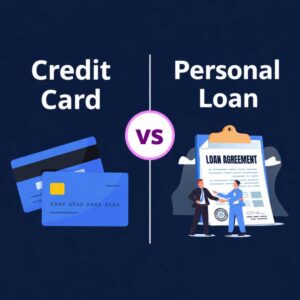
Personal Loan vs Credit Card
Depending on the amount and how quickly you can repay it, another credit product may sometimes be relevant.
A personal loan typically gives you a fixed amount with a structured repayment plan.
A credit card is revolving credit: you can use the available balance repeatedly as you repay it.
That flexibility can be useful, but it can also make debt easier to carry indefinitely.
Don’t assume one is always cheaper.
Compare the actual interest rate, fees and repayment behaviour involved.
For a large expense that will take years to repay, a structured personal loan may be easier to budget for.
For short-term spending that you can repay rapidly, the situation may be different.
Your actual product terms matter.
Personal Loan vs Payday or Short-Term Loan
Short-term credit is another regulated category in South Africa and is priced differently from normal unsecured personal loans.
NCR materials distinguish short-term credit from standard unsecured credit and provide separate maximum interest structures for these products. (NCR)
A small loan repaid quickly can still be expensive relative to the amount borrowed.
If you’re comparing a normal personal loan with a short-term product, don’t compare only the stated rate because one may be quoted monthly and another annually.
Compare the actual rand cost and total amount payable.
Never Borrow to Pay an Upfront “Loan Release Fee”
This deserves repeating.
If a supposed lender tells you:
“Your R100,000 loan is approved. Pay R1,500 first to release the money.”
Stop and verify the situation independently.
Scammers frequently rely on people being desperate for credit.
They may describe the payment as:
insurance
clearance
legal fees
tax
activation
or:
transfer charges.
Use the lender’s independently verified official contact details rather than numbers supplied in suspicious messages.
Compare Customer Service Too
Cost matters most, but service matters as well.
A loan can last several years.
Ask yourself:
Can I easily access statements?
Can I see the outstanding balance?
Is there an online/app facility?
Can I contact the lender if there’s a problem?
Are additional payments easy to make?
Are the terms explained clearly?
You don’t necessarily want to spend four years dealing with a lender that is almost impossible to contact.
Example of a Full Loan Comparison
Suppose you need R50,000.
You receive three offers:
| Feature | Lender A | Lender B | Lender C |
|---|---|---|---|
| Amount | R50,000 | R50,000 | R50,000 |
| Interest | 15% | 18% | 13.5% |
| Term | 48 months | 36 months | 60 months |
| Approx. Instalment* | R1,392 | R1,808 | R1,151 |
| Approx. Instalment Total* | R66,816 | R65,088 | R69,060 |
*Simplified illustration excluding fees and insurance.
Which is best?
You cannot answer just by looking at the instalment.
Lender C has the lowest monthly payment.
But its longer repayment term creates the highest approximate instalment total in this simplified example.
Lender B has the highest monthly repayment but finishes a year earlier than Lender A and two years earlier than Lender C.
Then you still need to add the real-world:
Initiation fee
Service fees
Credit-life insurance
and any other disclosed permitted costs.
Only then can you compare the complete offers properly.
A Personal Loan Comparison Checklist
Before accepting any personal loan, make sure you can answer all of these questions:
How much am I borrowing?
How much money will actually be paid to me?
What annual interest rate am I being charged?
Is the rate fixed or variable?
What is the monthly repayment?
How many repayments will I make?
What initiation fee applies?
What monthly service fee applies?
Is credit-life insurance included?
How much does the insurance cost?
What is the total amount repayable?
Can I comfortably afford the monthly instalment?
Could I still afford it if another household expense increased?
Can I make additional payments?
Can I settle early?
What happens if I miss a repayment?
Is the credit provider legitimate and appropriately registered?
If you don’t understand one of the answers, don’t be embarrassed to ask.
You are potentially signing a contract that will affect your finances for years.
Frequently Asked Questions
What is the best personal loan in South Africa?
There isn’t one personal loan that is automatically best for everyone.
The most appropriate loan depends on the personalised interest rate you’re offered, fees, insurance, repayment term, affordability and your financial circumstances.
Compare actual quotations rather than relying only on advertising.
Which bank has the lowest personal-loan interest rate?
Rates can be personalised.
Even if one institution advertises a low starting rate, you may receive a different rate based on its assessment of your application.
Compare personalised quotations using the same loan amount and repayment period.
Can I get a personal loan with a low credit score?
Approval is determined by the credit provider.
Credit history can influence lending decisions, but lenders may consider multiple factors including income, expenses and affordability.
A lower credit score doesn’t automatically produce the same outcome with every lender.
Does checking my credit report reduce my credit score?
Viewing your own consumer credit report is different from making multiple formal credit applications.
Checking your own report can be useful for identifying inaccuracies and understanding your credit position before applying.
How can I improve my chances of getting a lower interest rate?
There is no guaranteed method, but maintaining a healthy repayment history, reducing excessive debt, checking your credit report for genuine errors and improving your overall affordability can strengthen your credit position.
Is it better to take a loan over three years or five years?
A shorter term generally means a higher monthly repayment but lower total interest, assuming everything else is equal.
A longer term usually lowers the monthly instalment but may increase the total cost.
Choose a term that balances affordability with total borrowing cost.
Can I have more than one personal loan?
It is possible for consumers to have multiple credit agreements, but each additional debt increases your monthly commitments.
A responsible credit provider must assess affordability before granting regulated credit.
Just because another loan is approved doesn’t automatically mean taking it is a good financial decision.
What happens if I repay my loan early?
Early-settlement arrangements depend on the credit agreement and applicable National Credit Act provisions.
Ask your lender for a settlement quotation if you want to repay the loan completely.
Should I apply to several banks for personal loans?
Comparing lenders is sensible, but repeatedly submitting full applications simply to test approval can create multiple credit enquiries.
Research products first and make deliberate applications to legitimate credit providers.
Final Thoughts
Comparing personal loans in South Africa is not about finding the biggest amount somebody is willing to lend you.
It is about finding a loan that solves the financial need without creating a bigger problem later.
Start with the amount you genuinely need.
Then compare:
Interest rate
Repayment period
Monthly instalment
Initiation fee
Service fee
Credit-life insurance
and most importantly:
Total amount repayable.
Don’t automatically choose the loan with the lowest monthly repayment.
A smaller instalment may simply mean you’re paying the debt for another two or three years.
Don’t automatically choose the lender advertising the lowest “from” interest rate either.
Your personalised rate is what matters.
And don’t assume approval means affordability.
A lender can assess your application, but you still have to live with the repayment every month.
Look at your actual household budget. Leave room for unexpected expenses. Check your credit report before applying, verify that the lender is legitimate, and read your quotation carefully.
Personal loans can be useful financial tools when used responsibly.
They become dangerous when borrowers focus only on receiving the money and ignore what happens during the months and years of repayment.
Taking an extra hour to compare several legitimate offers could potentially save you thousands of rand and prevent years of unnecessary financial pressure.
The important question isn’t simply:
“Who will approve me?”
A better question is:
“Which offer gives me the amount I actually need at a repayment and total cost I can realistically manage?”
That is the comparison that matters.
Useful South African Resources
For additional information, readers can use these independent and official resources:
National Credit Regulator (NCR)
https://www.ncr.org.za/
The NCR provides information about the National Credit Act, registered credit providers, consumer rights and debt counselling.
South African Reserve Bank (SARB)
https://www.resbank.co.za/
The Reserve Bank publishes official information about South Africa’s monetary policy and policy interest rate. As of the July 2026 MPC decision, the SARB Policy Rate stood at 7.00%. (Reserve Bank of South Africa)
TransUnion South Africa
https://www.transunion.co.za/
Consumers can obtain information about credit reports, credit scores and credit-history management. TransUnion explains that lenders use credit information as one input when assessing applications and pricing credit. (TransUnion South Africa)
Experian South Africa
https://www.experian.co.za/
Experian provides consumer credit-report and credit-score services and educational information about credit profiles. (Experian South Africa)
Disclaimer: This article is provided for general educational purposes only and does not constitute personalised financial, legal or credit advice. Interest rates, fees, regulations and lending criteria may change. Always read the lender’s current pre-agreement quotation and credit agreement, confirm current regulatory information with the National Credit Regulator, and consider your own financial circumstances before entering into a credit agreement.