
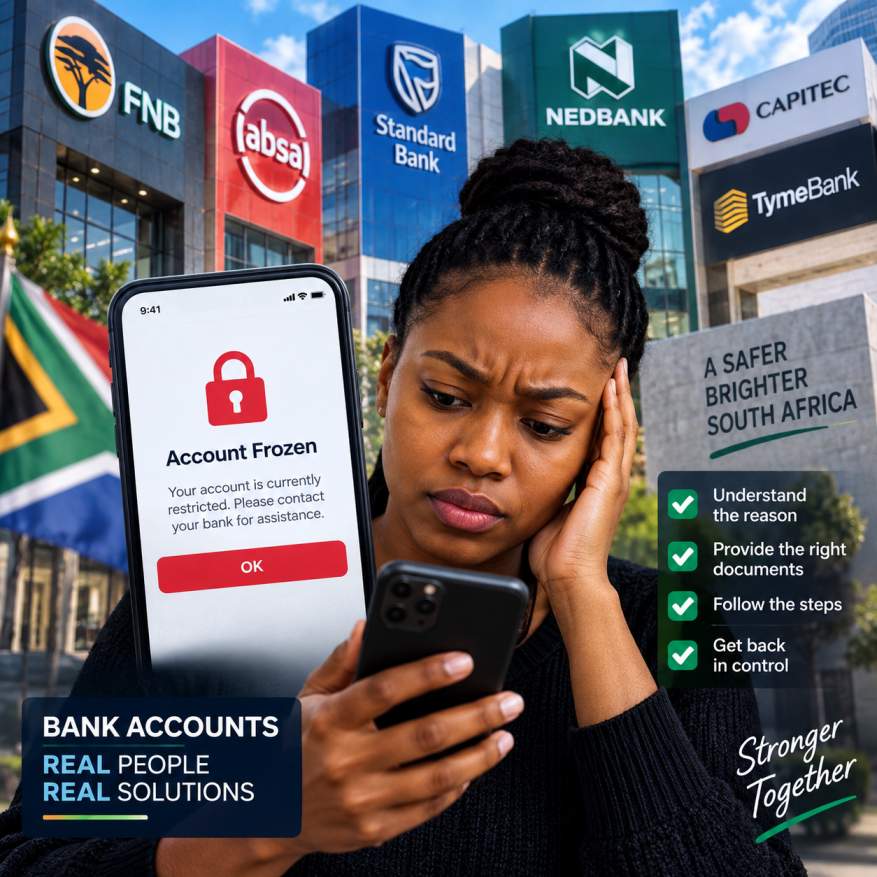
Imagine opening your banking app on payday and discovering that you cannot transfer money.
You try your card at a shop. Declined.
You attempt an EFT. It fails.
You try withdrawing cash from an ATM. Nothing.
Yet when you check your balance, the money may still appear to be sitting in the account.
For someone who needs to pay rent, buy groceries, travel to work or support a family, having a bank account restricted can quickly become a serious problem.
The first reaction is often:
“Why did my bank freeze my account?”
There isn’t one answer.
South African banks can restrict accounts for several different reasons, including incomplete customer information, FICA verification problems, unusual transactions, suspected fraud, security concerns and legal or regulatory requirements.
Sometimes the problem can be resolved relatively quickly by supplying updated information. Other cases — particularly those involving suspected fraud, disputed funds, investigations or legal orders — can be considerably more complicated.
This guide explains why South African bank accounts get frozen, restricted or blocked, what you can do about it and what to expect while the problem is being investigated.
What Does It Mean When a Bank “Freezes” Your Account?
“Frozen account” is an everyday expression rather than a description of one single banking process.
Depending on the reason, a bank may restrict only certain functions or prevent most activity on the account.
For example, you might be unable to:
- withdraw cash;
- make EFTs;
- use your debit card;
- make online purchases;
- use certain banking-app functions;
- make international payments;
- transfer funds between accounts;
- access money that has been placed on hold.
In other circumstances, only a particular transaction may be stopped.
That distinction matters.
A blocked transaction does not necessarily mean your entire bank account has been frozen.
Similarly, an account restriction caused by outstanding FICA information is not necessarily the same thing as an account affected by a fraud investigation.
Your first task should therefore be finding out exactly what has been restricted.
1. Your FICA Information Is Outdated or Incomplete
One of the most important reasons a South African bank may restrict an account relates to customer identification and due diligence.
Banks are accountable institutions under South Africa’s Financial Intelligence Centre Act framework.
The legislation doesn’t simply require banks to identify customers once when accounts are opened.
It requires ongoing due diligence.
Under section 21C of the Financial Intelligence Centre Act, accountable institutions must conduct ongoing monitoring of business relationships and keep relevant customer identification information up to date. This monitoring can include considering the source of funds and transactions that appear unusually large, complex or inconsistent with what the institution knows about the customer. (Financial Intelligence Centre)
This is one reason your bank occasionally asks you to:
- confirm your address;
- update your employment;
- confirm your occupation;
- update contact details;
- confirm your source of funds;
- provide identification;
- provide other information about your financial activity.
Ignoring those requests can eventually cause problems.
What Happens If You Don’t Update Your FICA Information?
The exact process differs between banks and circumstances.
However, banks can restrict services when required customer due-diligence information cannot be completed.
For example, Nedbank currently tells customers that failure to update or validate required information can result in an account being restricted or blocked. It says a blocked customer may lose access to funds, cards, the Money app and online banking until the necessary information has been supplied. (Nedbank Business)
Absa similarly explains that an account can enter what it calls a “FICA lock” when customer information is incorrect and the bank cannot successfully contact the customer. (Absa)
This demonstrates why messages requesting updated information should not automatically be ignored.
However, you should always update details through the bank’s official channels, because criminals frequently impersonate banks.
2. Your Bank Needs to Verify Your Identity
Sometimes the bank simply needs to confirm that you are really you.
This could happen because:
- identification information has changed;
- records are incomplete;
- your ID needs to be reconfirmed;
- your address changed;
- information provided previously no longer matches;
- the bank has doubts about information on file.
The FIC Act specifically provides for further verification when an institution doubts the adequacy or accuracy of information previously obtained.
That doesn’t automatically mean you have done something wrong.
Banks have ongoing legal compliance obligations.
What Documents Could the Bank Ask For?
The documents depend on your bank and the reason for the restriction.
You could potentially be asked for:
- South African ID book or smart ID;
- passport;
- proof of residential address;
- proof of income;
- payslip;
- bank statements;
- employment information;
- information explaining your source of funds;
- company documentation for a business account;
- supporting documents for unusual transactions.
For example, Absa’s current FICA information says an individual dealing with a FICA lock may need to confirm information including occupation, occupational status and source of funds, along with identity and address documentation. (Absa)
Don’t assume that every customer will be asked for exactly the same documents.
Ask your bank:
“What specific documents or information do you require from me to remove the restriction?”
Write the answer down.
3. An Unusual Transaction Triggered Security Checks
Suppose your normal account activity looks like this:
Salary: R18,000
Monthly transactions: R500 to R5,000
Typical balance: below R20,000
Then suddenly:
R250,000 enters the account.
That does not automatically mean the money is illegal.
Perhaps you:
- sold a vehicle;
- received an inheritance;
- sold property;
- received a legitimate business payment;
- received an insurance payout;
- transferred your own savings;
- received money from overseas.
But the transaction may look significantly different from your normal account behaviour.
South African financial institutions are required to monitor transactions as part of ongoing customer due diligence.
The FIC Act specifically refers to monitoring transactions and, where necessary, considering source of funds and examining complex, unusually large transactions or unusual transaction patterns without an apparent lawful or business purpose. (Financial Intelligence Centre)
The bank may therefore require additional information.
Example: R180,000 Suddenly Enters a Personal Account
Consider this fictional example.
Sipho normally receives a salary of R22,000 per month.
His account generally receives:
- R22,000 salary;
- small transfers from family;
- ordinary refunds.
Then R180,000 arrives.
The money is legitimate.
Sipho sold his vehicle privately.
If his bank asks about the transaction, useful supporting evidence could potentially include:
- vehicle sale agreement;
- proof of ownership;
- correspondence concerning the transaction;
- buyer information where appropriate;
- proof of payment;
- other documents requested by the bank.
The important point is:
Unusual doesn’t automatically mean illegal.
But unusual transactions can require explanation.
4. Your Bank Suspects Fraud
Another major reason for restricting an account is suspected fraud.
The bank could identify activity that appears inconsistent with your normal behaviour.
Examples might include:
- unusual transfers;
- multiple unexpected payments;
- rapid movement of funds;
- transactions from unfamiliar devices;
- unusual card activity;
- suspected account takeover;
- disputed payments;
- suspected scam proceeds.
A restriction in this situation may actually be protecting you.
Imagine a criminal gains access to your account containing R45,000.
The criminal tries transferring:
R10,000
R15,000
R20,000
within minutes.
If the bank’s fraud controls stop subsequent transactions, the temporary inconvenience could prevent a much larger loss.
5. Someone Reported Money Sent to Your Account as Fraudulent
This can be more complicated.
Imagine somebody transfers R30,000 into your account.
Shortly afterwards, the sending bank receives a fraud complaint.
Your account could become involved in an investigation.
This doesn’t automatically establish that you committed fraud.
There are legitimate situations where innocent people receive disputed money.
But the bank may need to establish what happened.
This is particularly important because fraud proceeds can move through multiple bank accounts extremely quickly.
A recent 2026 South African case illustrates the scale these situations can reach. The National Prosecuting Authority reported an online banking scam involving approximately R21.55 million, after which intervention ultimately resulted in funds in nine bank accounts being frozen and a High Court preservation order being obtained. (National Prosecuting Authority)
Most consumer disputes will obviously involve much smaller amounts.
But the example demonstrates why financial institutions can act quickly when suspected fraud is involved.
6. Your Account May Have Been Used as a Money Mule Account
A money mule is generally someone whose bank account is used to receive or move money connected to criminal activity.
Sometimes people knowingly participate.
Others may be manipulated.
For example:
Someone contacts you and says:
“Can I send R20,000 to your account? Just withdraw it for me and I’ll give you R2,000.”
That should immediately raise concerns.
Another person may say:
“My bank account isn’t working. Let my customer pay into yours.”
Or:
“I’ll send money to you. You just transfer it to another account.”
Even when the promised commission looks attractive, allowing strangers or loosely known individuals to route money through your bank account can create serious consequences.
Your bank account should not be rented out.
The R2,000 “Easy Money” Example
Suppose someone offers you R2,000 to receive R30,000.
You receive:
R30,000
You transfer:
R28,000
You keep:
R2,000
A day later, the original R30,000 is reported as proceeds of fraud.
From the bank’s perspective, your account received disputed funds and rapidly transferred most of them onward.
Now you may need to explain:
- who sent the money;
- why they sent it;
- who received the R28,000;
- why you kept R2,000;
- what relationship you have with the people involved.
That R2,000 can turn into an extremely serious problem.
7. The Bank Thinks Your Account Has Been Compromised
Not every restriction means the bank suspects you.
The bank could suspect someone else has gained access to your account.
Warning signs might include:
- logins from unusual devices;
- password changes;
- SIM-related concerns;
- unusual beneficiary additions;
- unexpected payment attempts;
- unusual online purchases;
- multiple failed authentication attempts.
In these situations, the bank may restrict transactions while verifying your identity.
If you receive an unexpected fraud alert, contact your bank through a number you independently know is legitimate.
Do not simply call the number contained in a suspicious SMS.
Be Extremely Careful When Someone Calls Saying Your Account Is Frozen
Fraudsters understand that fear creates urgency.
A caller might say:
“I’m calling from your bank’s fraud department. Your account is being frozen right now.”
Then they ask for:
- your OTP;
- banking PIN;
- card PIN;
- password;
- card details;
- approval of an app notification;
- installation of remote-access software.
This could be the scam itself.
The Southern African Fraud Prevention Service warned in 2025 about vishing scams where criminals impersonate legitimate organisations, including banks, and manipulate victims into revealing sensitive information or interacting with fraudulent links. (Safps)
If you’re uncertain, end the call.
Then contact your bank independently through its official app, website, branch or verified telephone number.
8. A Court Order or Legal Process May Affect the Account
Some account restrictions have nothing to do with missing FICA documents.
Funds can become subject to legal processes.
These cases can be much more complicated than ordinary verification restrictions.
If a restriction involves:
- a court order;
- preservation order;
- criminal investigation;
- asset forfeiture;
- insolvency;
- deceased estate;
- other formal legal process,
simply updating your address will obviously not solve the underlying issue.
You need to find out the legal basis for the restriction and consider obtaining appropriate legal advice.
9. Targeted Financial Sanctions Can Affect Access to Funds
South Africa also maintains targeted financial-sanctions obligations through the Financial Intelligence Centre framework.
The FIC maintains a Targeted Financial Sanctions system with listed individuals and entities and mechanisms relating to permitted financial services. (TFS)
These circumstances are completely different from an ordinary consumer whose proof of address expired.
The important lesson is that the term “frozen account” covers very different situations.
That’s why identifying the reason is the most important first step.
10. Your Business Activity Doesn’t Match the Account Profile
Suppose you opened a personal account while employed and told the bank your primary source of funds was salary.
Two years later you start a successful business.
The account now receives:
- 80 customer payments per month;
- deposits of R150,000;
- payments from multiple companies;
- international transfers.
Even if every rand is legitimate, the account activity now looks completely different from the customer profile originally established.
This can result in questions about:
- source of funds;
- nature of business;
- expected transaction volumes;
- beneficial ownership;
- business registration;
- tax or supporting records where relevant.
Keeping your banking profile accurate can reduce unnecessary complications.
11. Your Contact Details Are Outdated
This sounds minor but can become important.
Suppose the bank tries contacting you regarding information that must be updated.
But:
Your phone number changed.
Your email address is old.
You moved house.
You never updated your profile.
Now the bank cannot reach you.
Absa specifically notes that its FICA-lock process can arise where information is incorrect and it cannot contact the customer. (Absa)
Keep your details current.
That includes:
- mobile number;
- email;
- address;
- employment;
- occupation;
- source of funds where relevant.
What To Do Immediately If Your Bank Account Is Frozen
If you discover a restriction, don’t panic and don’t start randomly trying dozens of transactions.
Use a structured process.
Step 1: Check the banking app
Look for:
- notifications;
- secure messages;
- FICA requests;
- fraud alerts;
- verification requests;
- transaction notices.
Take screenshots where appropriate for your records.
Step 2: Check Your Email and SMS Messages
Search for legitimate messages from your bank concerning:
- customer information updates;
- FICA;
- identity verification;
- suspicious transactions;
- account reviews.
Be careful.
A message claiming to be from your bank isn’t automatically genuine.
Don’t click suspicious links.
Step 3: Contact the Bank Through an Official Channel
Use:
- the official banking app;
- a verified telephone number;
- the bank’s official website;
- a branch.
Ask:
“Is my account restricted?”
Then:
“What is the reason for the restriction, and what do you require from me?”
The bank may not always be able to disclose every detail, particularly in cases involving financial-crime controls or investigations.
But you need enough information to understand what action is required from you where disclosure is permitted.
Step 4: Ask Whether the Whole Account or Only One Transaction Is Restricted
This is extremely important.
Ask whether:
- the entire account is blocked;
- only outgoing transactions are blocked;
- cards are restricted;
- online banking is restricted;
- only a particular payment is on hold;
- incoming payments can still be received.
Knowing the scope of the restriction helps you plan.
Step 5: Ask Exactly What Documents Are Required
Don’t leave with:
“Bring FICA documents.”
Ask specifically:
Which documents?
For example:
- ID?
- proof of address?
- payslip?
- employment confirmation?
- source-of-funds documents?
- sale agreement?
- company documents?
- proof explaining a transaction?
Then collect everything before returning.
Step 6: Explain Unusual Transactions Clearly
Suppose the bank asks:
“Where did this R95,000 come from?”
Don’t respond:
“It’s my money.”
Explain it.
For example:
“I sold my vehicle for R95,000 on 2 September. The buyer paid by EFT. I have the sale agreement and supporting documentation.”
Or:
“The R120,000 came from my fixed-deposit account at another bank. Both accounts are in my name.”
Or:
“The R60,000 was an insurance payout. Here is the settlement documentation.”
The easier it is to establish a legitimate paper trail, the easier it may be for the relevant team to understand the transaction.
Step 7: Get a Reference Number
Whenever possible, obtain a:
- case number;
- complaint number;
- fraud reference;
- branch reference;
- service request number.
Record:
- date;
- time;
- department;
- name of representative where available;
- documents submitted;
- promised next step.
This becomes particularly important if the problem continues for days or weeks.
Step 8: Keep Copies of Everything
Don’t hand over your only copy of an important document without retaining a copy.
Create a folder containing:
- ID documents;
- proof of address;
- bank correspondence;
- transaction proof;
- contracts;
- sale agreements;
- payslips;
- screenshots;
- reference numbers.
If the dispute escalates, this record becomes extremely useful.
How Long Does It Take to Unfreeze a Bank Account?
There is no universal timeframe.
It depends heavily on the reason.
Simple information update
Potentially relatively quick once all information is verified.
For example, Nedbank currently says that after required information is updated, a restriction associated with its ongoing due-diligence process can be lifted within 48 hours. (Nedbank Business)
Absa says its quality-assurance process for removing a FICA lock can take up to 48 business hours after all required documents have been supplied. (Absa)
Those are examples from those specific banks — not a guarantee that every South African bank restriction will be resolved within 48 hours.
Fraud investigation
Potentially longer.
Disputed incoming funds
Potentially longer.
Court/legal restriction
Potentially much longer and dependent on the legal process.
Why Can’t the Call-Centre Agent Just Unblock It?
Because the person answering the phone may not have authority to override the restriction.
A bank can have separate teams dealing with:
- customer service;
- fraud;
- FICA/compliance;
- financial crime;
- legal matters;
- account security;
- quality assurance.
The frontline employee may only be able to tell you what documentation is outstanding or refer the case to the appropriate department.
Getting angry with a call-centre employee generally won’t bypass an internal compliance process.
Focus instead on getting:
- the reason;
- requirements;
- reference number;
- expected next step.
What If Your Salary Is Paid Into the Frozen Account?
This can create an urgent problem.
You may have:
- rent due;
- debit orders;
- school expenses;
- groceries;
- transport;
- electricity.
Tell the bank clearly that the restriction is causing financial hardship.
Ask:
- whether incoming salary payments will still be received;
- whether essential payments can be processed;
- what access, if any, remains available;
- whether the matter can be escalated;
- whether any alternative procedure is available.
Don’t assume the answer will be yes.
It depends on the nature of the restriction.
What About Debit Orders?
Again, it depends on the type of restriction.
Some restrictions may prevent outgoing payments.
Others may affect only specific functionality.
If you have upcoming debit orders for:
- bond;
- vehicle finance;
- insurance;
- medical aid;
- loans;
- subscriptions,
contact the bank and determine whether they will still process.
If they won’t, consider contacting the service provider before the debit order fails.
Explain that there is a temporary banking issue and ask what legitimate alternative payment options are available.
Don’t Try to “Solve” a Frozen Account by Moving Suspicious Money Elsewhere
Suppose R50,000 enters your account and the bank asks questions about it.
Trying to immediately move the money through multiple accounts is unlikely to make the situation look simpler.
It can make the transaction trail more complicated.
If legitimate funds are questioned, provide legitimate evidence.
Don’t Create Fake Proof of Funds
Never fabricate:
- payslips;
- invoices;
- sale agreements;
- employment letters;
- proof of address;
- bank statements;
- contracts.
If you don’t have a requested document, tell the bank and ask whether another legitimate document can satisfy the requirement.
Creating false documentation can turn an administrative problem into a much more serious matter.
Don’t Pay Someone Who Claims They Can “Unlock” Your Bank Account
Be suspicious of people on social media claiming:
“I have someone inside the bank.”
or:
“Pay me R2,000 and I’ll remove the block.”
Do not provide strangers with:
- banking login details;
- PINs;
- OTPs;
- passwords;
- remote access to your phone.
Deal directly with the bank.
What If the Bank Won’t Resolve the Problem?
Start with the bank’s formal complaints process.
Don’t rely only on repeated telephone calls.
Submit a formal complaint and retain the reference number.
Explain:
- when the restriction started;
- what the bank requested;
- when you supplied it;
- what transactions are affected;
- what financial harm the restriction is causing;
- what resolution you’re requesting.
Keep the complaint factual.
Escalating a Banking Complaint in South Africa
If the bank’s internal complaints procedure does not resolve an eligible dispute, South African consumers may potentially approach the National Financial Ombud Scheme South Africa (NFO).
The former Ombudsman for Banking Services now operates within the NFO framework.
The NFO explains that banking customers must generally first follow the bank’s own complaint-handling procedure before approaching the Ombud for assistance. The service is available to qualifying consumers without charge. (NFOSA)
This is an important escalation route when a genuine banking-service dispute remains unresolved.
What Evidence Should You Keep for a Complaint?
Create a timeline.
For example:
3 September — 08:20
Card declined.
3 September — 09:05
Called bank.
Reference: ABC123.
Told proof of address required.
3 September — 11:30
Submitted proof of address and ID.
5 September — 14:00
Account still restricted.
Called again.
Reference: DEF456.
7 September
Formal complaint submitted.
Attach relevant supporting documentation.
A timeline is much easier for a complaint investigator to understand than a vague statement that:
“The bank has been messing me around forever.”
Example 1: Outdated FICA Information
Situation
Naledi’s bank has repeatedly requested updated information.
She ignores the messages because she assumes they are marketing.
Her account is eventually restricted.
What she should do
- Verify that the restriction is genuine.
- Contact the bank through an official channel.
- Ask what information is outstanding.
- Supply the required information.
- Obtain a reference number.
- Ask when the restriction is expected to be reviewed.
This may be relatively straightforward.
Example 2: Large Legitimate Payment
Situation
Jerome normally receives R25,000 salary.
He sells a car for R210,000.
The buyer transfers the full amount into his account.
The transaction triggers additional checks.
Useful approach
Jerome should retain:
- sale agreement;
- proof relating to the vehicle;
- payment record;
- relevant communication;
- any other information the bank requests.
A legitimate large transaction can usually be explained with legitimate documentation.
Example 3: Fraudulent Money Reaches an Innocent Person
Situation
A person selling a laptop online receives R18,000.
They hand the laptop to the buyer.
Later, the payment becomes associated with a fraud complaint.
Now the seller’s account is affected.
What should they keep?
- advertisement;
- buyer messages;
- proof of sale;
- serial number;
- delivery/collection evidence;
- identity information legitimately obtained during the transaction;
- proof of payment;
- police case information if applicable.
Online sellers should keep proper transaction records for expensive items.
Example 4: Someone Asks to Borrow Your Bank Account
Situation
A friend says:
“My account reached its limit. Let R40,000 come into yours and I’ll give you R3,000.”
Best response
Don’t do it.
You don’t know the true origin of the money.
The R3,000 isn’t worth potentially having your account associated with disputed or criminal funds.
Can the Bank Keep Your Account Frozen Forever?
An ordinary temporary verification restriction shouldn’t simply be viewed as permanent by default.
But there is no single maximum period applicable to every type of account restriction.
The duration depends on:
- why it was imposed;
- applicable legislation;
- internal investigation;
- documentation required;
- third-party claims;
- court processes;
- regulatory requirements.
This is why online claims such as:
“A bank has exactly seven days to unblock you”
should be treated cautiously unless tied to the specific legal situation involved.
Can You Open Another Bank Account While One Is Frozen?
Potentially, but opening another account doesn’t necessarily resolve the original problem.
And if the underlying issue concerns:
- identity;
- suspected fraud;
- financial crime;
- legal restrictions,
trying to move activity elsewhere could create additional complications.
Resolve the original problem properly.
How to Reduce the Risk of Future Account Restrictions
You cannot guarantee that your account will never be reviewed.
But you can reduce avoidable problems.
Keep your details current
Update:
- phone number;
- email;
- address;
- occupation;
- employment;
- relevant source-of-funds information.
Respond to legitimate bank requests
Verify the communication independently if uncertain.
Then respond through official channels.
Keep records of large transactions
If you sell a car for R150,000, keep the paperwork.
If you receive an inheritance, keep the estate documentation.
If you receive a large business payment, retain invoices and contracts.
Don’t lend your account to other people
Your account should reflect your own legitimate financial activity.
Protect your login information
Never share:
- PIN;
- password;
- OTP.
Review transactions regularly
The faster you notice fraud, the faster you can report it.
A Useful Source-of-Funds Folder
One practical idea is to maintain a secure digital folder for significant financial transactions.
For example:
CAR SALE 2026
- sale agreement.pdf
- proof of ownership.pdf
- buyer payment.pdf
INSURANCE PAYOUT
- claim.pdf
- settlement letter.pdf
- payment confirmation.pdf
BUSINESS
- invoices
- contracts
- customer payment records
This isn’t about living in fear of your bank.
It’s good financial record keeping.
Frozen Account Checklist
If your account becomes restricted, work through this checklist:
- Check banking-app notifications.
- Check legitimate bank communications.
- Contact the bank through an official channel.
- Ask exactly what is restricted.
- Ask why, to the extent the bank can disclose it.
- Ask exactly what information/documents are required.
- Submit documents promptly.
- Keep copies.
- Get a reference number.
- Record dates and conversations.
- Follow up within the timeframe provided.
- Submit a formal complaint if the issue isn’t being handled properly.
- Consider approaching the National Financial Ombud if the bank’s complaints process fails and the matter falls within its jurisdiction.
Frequently Asked Questions
Why did my bank suddenly freeze my account?
Possible reasons include FICA/customer-information problems, identity verification, suspicious or unusual transactions, suspected fraud, security concerns or a legal/regulatory restriction.
You need to ask your bank about your specific situation.
Can a bank block my account because my FICA information is outdated?
Yes, customer due-diligence requirements can lead to restrictions where required information cannot be completed. South African banks including Nedbank and Absa explicitly warn customers about restrictions associated with outstanding FICA/customer information. (Nedbank Business)
How long does a FICA block take to remove?
It depends on the bank and circumstances.
For example, Nedbank currently states that an applicable restriction can be lifted within 48 hours after the required information has been updated, while Absa says removing its FICA lock can take up to 48 business hours after all required documentation has been provided and verified. (Nedbank Business)
These timeframes should not be assumed to apply to fraud or legal investigations.
Will my salary still enter a frozen account?
It depends on the type of restriction.
Contact the bank immediately and ask specifically whether incoming credits can still be received and whether you will be able to access them.
Can I withdraw my money while the account is frozen?
Possibly not.
Some restrictions prevent access to funds entirely, while others affect only certain services or transactions.
Can my bank freeze my account because I received a large amount?
A large transaction isn’t automatically wrongdoing. However, banks have obligations to conduct ongoing transaction monitoring, including consideration of unusually large or unusual transactions and source of funds where necessary. (Financial Intelligence Centre)
Be prepared to explain legitimate transactions and provide supporting evidence where requested.
What if the bank won’t tell me why the account is frozen?
Ask what information the bank is legally permitted to provide and what steps you need to take.
Certain financial-crime situations may limit what the bank can disclose.
Can I complain about a frozen bank account?
Yes.
Start with your bank’s formal complaint process. If an eligible banking dispute remains unresolved, the National Financial Ombud may be able to assist after the bank’s complaints procedure has been followed. (NFOSA)
Should I give the bank my OTP to unblock my account?
Never give an OTP to someone simply because they call claiming to represent your bank.
If you’re uncertain about a communication, terminate the interaction and contact the bank yourself through an independently verified official channel.
Can I receive someone else’s money and withdraw it for them?
Doing this can expose you to serious risk, particularly when you don’t know the true source of the money.
Don’t allow other people to use your account as a channel for moving funds.
Final Thoughts
Finding your South African bank account frozen can be frightening, especially when your salary and savings are sitting inside it.
But your first response should be systematic rather than panicked.
Start by establishing what type of restriction you’re dealing with.
A FICA information lock can be completely different from a fraud investigation.
A blocked card can be different from a frozen account.
A suspicious transaction review can be different from a court-ordered restriction.
Once you understand the problem, establish exactly what the bank needs.
If it needs your updated address, provide legitimate proof.
If it needs your identity confirmed, follow the official verification procedure.
If it wants to understand a legitimate R150,000 transaction, provide the paper trail explaining where the money came from.
And keep records of everything.
South African financial institutions have substantial obligations under the FIC Act. Those include identifying customers, keeping relevant information updated and conducting ongoing due diligence that monitors transactions and, where necessary, their source and purpose. (Financial Intelligence Centre)
Those controls exist partly to combat money laundering, fraud and other financial crime.
But customers also have legitimate expectations that their banking concerns will be dealt with appropriately.
If you have provided everything requested and believe your bank is failing to handle the matter properly, use the bank’s formal complaint system rather than relying indefinitely on ordinary call-centre conversations.
Keep reference numbers.
Keep documents.
Keep a timeline.
And where an eligible banking dispute remains unresolved after following the bank’s process, South Africa’s National Financial Ombud provides an independent complaint mechanism for consumers. (NFOSA)
Most importantly, don’t try to bypass a banking restriction through fake documents, borrowed accounts or people online claiming they can “unlock” your money.
Find out why the restriction exists.
Provide legitimate evidence.
Follow the proper escalation process.
That is usually the safest path toward getting legitimate access to your banking services restored.
Important: This article provides general educational information and does not constitute personalised legal, financial or banking advice. Account restrictions differ according to the bank, circumstances, applicable legislation and any investigation or legal process involved. Contact your bank directly for information about your specific account and seek appropriate professional legal advice where necessary.
Authoritative Resources
For South Africa’s customer due-diligence requirements, see the Financial Intelligence Centre’s guidance and the Financial Intelligence Centre Act.
Consumers with an unresolved qualifying banking complaint can also approach the National Financial Ombud Scheme South Africa after following the bank’s internal complaint procedure.